In this climate a terrace is a room you can use nine months a year, which makes it the cheapest square metres you will ever add. But it sits over someone’s ceiling, so it is a waterproofing job before it is a design one.
There are two reasons people renovate a terrace, and they lead to very different jobs. Either it leaks — into your own ceiling or a neighbour’s — or you want to use it properly. If it leaks, the work is the membrane and the drainage and the finish is a consequence. If you want to use it, the work is shade, lighting, surfaces and sometimes an outdoor kitchen, and the membrane still has to be right underneath.
A terrace is a flat roof with furniture on it. The membrane, the falls and the drainage outlets are the whole structure of the job: water has to reach an outlet from every part of the surface, the membrane has to be continuous and turned up at every edge and threshold, and the outlets have to be accessible for cleaning. Many terrace leaks come down to a blocked outlet or a membrane that was never turned up behind the threshold.
In a flat, the terrace is also usually not entirely yours. A roof terrace or a balcony is often an element común de uso privativo — common property for your exclusive use — which means the waterproofing and the structure can be the building’s responsibility while the finish is yours. That distinction decides who pays, and it is worth establishing before you commission anything. We will tell you what we find; the statutes are for your lawyer or your administrator.
Once it is watertight, this is the best value renovation in Catalonia. Shade is the thing that actually determines whether a terrace gets used in July — a pergola or awning extends the usable hours considerably. Add warm lighting and the terrace becomes an evening room. If you are also dealing with damp inside, see damp treatment, and insulation and waterproofing for the technical detail.
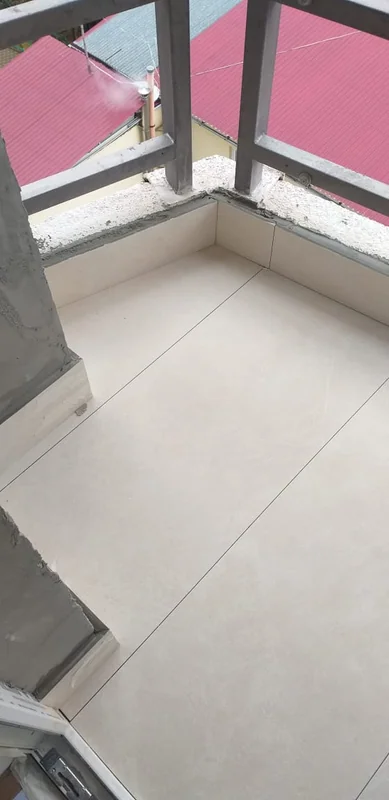
One to four weeks depending on size and on whether the membrane is being replaced. The weather genuinely matters on this one — membranes do not go down in the rain.
We check the falls, the outlets, the thresholds and the edges, and where there is a leak we work out where the water is actually getting in rather than guessing. That diagnosis decides the whole scope.
Old paving and screed up, down to the structural deck. This is when we find out what the previous membrane was and whether it was ever turned up at the edges.
Screed laid to fall towards the outlets from every point, with new outlets where the existing ones are undersized or in the wrong place. No amount of membrane fixes a surface that ponds.
A continuous membrane across the deck, turned up at every parapet, threshold and penetration. Flood-tested before anything goes on top of it, because afterwards you cannot.
Over a habitable room below, insulation above the membrane makes a real difference to the room’s summer temperature. On a balcony over outside air it usually is not worth the height.
Porcelain on adjustable pedestals where the height allows — which keeps the membrane accessible and the surface flat — or bonded paving, timber decking or microcement.
Pergola or awning, outdoor lighting on its own circuit, planters sized so they are not sitting directly on the membrane, and any outdoor kitchen or services.
Outlets checked, surface tested, warranty handed over.
We come and look, and where there is a leak we tell you where it is coming from. Free, no obligation, anywhere in Catalonia.
Waterproofing quoted separately from the finishes, so you can see what is essential and what is choice — and so you can do the essential part now and the rest later.
One person coordinates the roofer, the paver and the electrician, and watches the weather so the membrane goes down dry.
A tested, watertight terrace with a warranty on the waterproofing specifically, not just on the work in general.
Ponding, a blocked outlet, a membrane never turned up behind the threshold — these are different problems with different prices. Diagnosis first, then a quote.
A terrace that ponds will leak eventually whatever you waterproof it with. We re-screed to proper falls and add outlets where they are needed.
We test the membrane while we can still get at it. Once the paving is down, finding a fault means taking it all up again.
Porcelain on adjustable pedestals keeps the membrane reachable, drains underneath and sits dead level. It is the right answer far more often than it is specified.
Where the terrace is common property for your private use, we say so, because the building may owe the waterproofing. We would rather tell you that than quietly invoice you for it.
A pergola or awning is what decides whether the terrace gets used in summer. We design shade as part of the job, not as an afterthought.
Per square metre of terrace, VAT excluded. Waterproofing-only is quoted separately below.
| Specification | What it covers | Per m² (excl. VAT) | |
|---|---|---|---|
| Functional | Standard finishes, practical solution | 120 – 250 €/m² | |
| Mid-range | Selected materials, best balance | 250 – 400 €/m² | |
| Outdoor living / high | Premium materials and high-end interior design | 400 – 700 €/m² |
Indicative only. VAT excluded. The final figure is a fixed written quote after the free survey.
Indicative ranges for a complete terrace renovation, VAT excluded.
A flat balcony or small terrace. New paving, waterproofing and perhaps an awning. On a street-facing balcony check first whether the façade is protected.
The most common size on penthouses and flats. Enough for an outdoor dining area and a pergola.
Generous roof terraces. Seating zones, an outdoor kitchen, even a hot tub — though that needs the structure checked and usually strengthened first.
Where the problem is leaks: renew the membrane and the outlets and re-pave. The right first phase if the budget is tight.
Two things change these figures. Access: a roof terrace with no lift and a narrow stair means every bag of screed and every slab goes up by hand, and that is real money on a large terrace. And structure: a hot tub, raised planters or heavy paving may need the deck checked and strengthened, which we would rather establish at survey than after.
What a turnkey terrace renovation covers, and what sits outside it.
VAT (10% or 21% depending on your case) is shown as its own line. One thing worth raising early: if the terrace is common property for your exclusive use, the building may be liable for the waterproofing while you pay for the finish. Check with your administrator before you commission the work — it is a conversation worth having before you spend.
Terraces are often done alongside a wider renovation, and we coordinate either way.
Terraces and balconies in Barcelona and across Catalonia. Find your town.
Official boundary data for comarques and municipalities (ICGC, 2025).
What people ask about terraces, usually after a leak.
First find where the water is getting in, because the three usual causes have very different costs. A blocked or undersized outlet is cheap. A membrane that was never turned up behind the threshold or the parapet is a strip-out of that edge. A failed membrane across the whole deck is a full renovation. We diagnose before quoting. And establish early whether the terrace is your private property or common property for your private use, because that decides who pays.
From about 40 €/m² for renewing the membrane and outlets, and roughly 90 to 150 €/m² including a new paved finish on top. For a typical 15 m² terrace that is about 1,350 to 2,250 € including paving. Full renovations with shade, lighting and outdoor living run 250 to 700 €/m². The waterproofing is quoted separately on purpose, so you can do the necessary part first.
It depends on how the terrace is classified in the building’s deeds, and it is worth finding out before you spend. A terrace that is your private property is yours entirely. A terrace or balcony that is an element común de uso privativo — common property for your exclusive use — commonly splits: the building is responsible for the structure and waterproofing, you are responsible for the finish and the upkeep. We will tell you what we find on site; the deeds and statutes are for your administrator or lawyer.
Pedestals where the height allows, and it is under-specified. Porcelain slabs on adjustable pedestals sit dead level, drain underneath, and can be lifted to reach the membrane and clean the outlets — which you will want to do. Bonded paving is cheaper and is the answer where you cannot afford the height. Timber decking is warm underfoot and needs annual attention; composite needs less but looks like composite. Microcement is seamless and, in this climate, needs to be laid by someone who really knows it.
Over a habitable room, yes, and noticeably — a roof terrace is the hottest surface of the flat in August and insulation above the membrane makes the room below materially cooler. Over outside air, as with most balconies, it is usually not worth the height you lose. If we are taking the terrace up anyway, insulation is the cheapest it will ever be, so we price it as an option rather than leaving it out.
Usually yes, in two directions. The council may require a notification or licence for a fixed structure, and the residents’ association generally has a say because anything visible changes the look of the building — and on a protected façade in Barcelona, the heritage rules apply too. Retractable awnings in a colour the building has already approved are the path of least resistance. We file the paperwork; see awnings and pergolas.
Sometimes, and never without checking the structure first. A filled hot tub with people in it is a concentrated load of well over a tonne, which is more than many terrace decks were designed for. It needs an engineer’s assessment and often localised strengthening, plus power, water and a drainage route. We will tell you at survey whether your deck is a candidate, and we will not fit one on an unassessed structure.
One to four weeks depending on size and whether the membrane is being replaced — and yes, the weather genuinely matters, which is unusual for us. Membranes cannot be laid onto a wet deck or in the rain, and screeds need dry time. We plan terrace work around the forecast and will delay a membrane day rather than lay it badly, which is why we do not promise a fixed day for that phase.
Occasionally, and we will say so when it is genuinely fine — if the existing surface is sound, falls correctly and is not leaking, a bonded or pedestal finish over the top saves a strip-out. But if the terrace is leaking, paving over it buries the problem under something you have just paid for. We flood-test before recommending it rather than guessing.
In this climate it is the best square-metre value available. Usable outdoor space is among the most sought-after features in the Barcelona market, and a terrace that works adds nine months of usable room for a fraction of what interior square metres cost. The part that is purely protective — waterproofing — does not add value so much as prevent loss, and that is also the part you cannot sensibly defer.
Practical guides to prices, materials, permits and the decisions that come up on site — so you can plan your flat refurbishment with your eyes open.
10,000 € buys a bathroom or a kitchen; a 60 m² flat starts at 34,400 € at functional level. What each budget covers up to 150,000 €, before VAT.
Read the article →Guides and adviceWhat a technical architect (aparejador) charges in Spain in 2026: fee percentages, fixed prices, what drives the cost and when hiring one is compulsory.
Read the article →Full renovationsWhat an architect charges for a renovation in 2026: typical rates, fees as a share of the PEM budget and how to keep the total under control.
Read the article →Free survey and leak diagnosis anywhere in Catalonia. Waterproofing quoted separately from the finishes.

