Getting a unit ready to trade is not just making it look good. It means meeting the rules on the activity, accessibility and fire protection so that you can legally open — and since every closed day costs money, we work to short, written programmes.
A commercial unit — a local in Spanish — is usually rented or bought as a shell, and the work between getting the keys and opening the doors is where the money and the time go. Rent starts on day one, so every week of delay is a week of paying for a unit that is not trading. That makes the programme at least as important as the price.
Underneath the design is a layer of compliance that decides whether you can open at all. Depending on the activity and the municipality, you will need either a prior communication or an activity licence, and the unit will have to meet the rules on accessibility, fire protection and, for some activities, smoke extraction and noise. A unit that previously held a similar activity starts with a head start; a shell, or a unit formerly used for something different, does not.
We start with the activity and the paperwork, not the finishes. We tell you what your type of business needs, draft the activity project through registered technicians, and then build to a fixed written programme. If you are weighing a unit that was previously a shop for conversion into a home, that is a different process: commercial-to-residential conversions. For the licence side in detail, see permits and drawings.
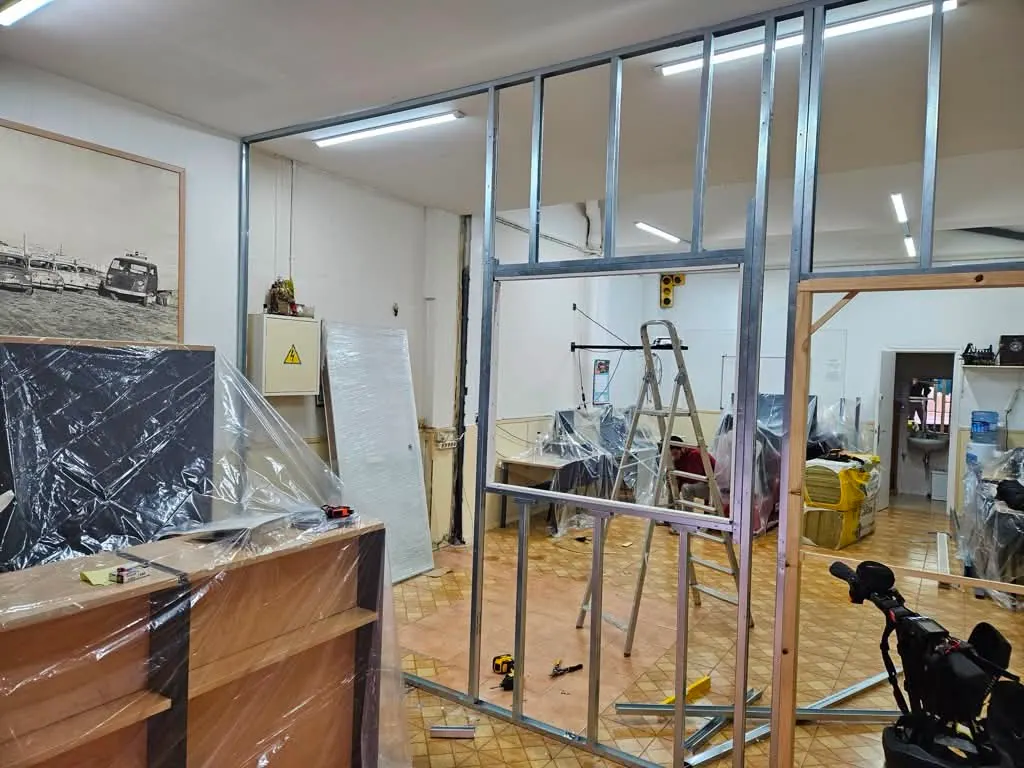
Typically four to twelve weeks of building, depending on the unit. The paperwork runs in parallel, and it is usually the paperwork that sets the opening date.
We inspect the unit, establish what your activity requires and what the unit already has, and give you a fixed quote and a programme.
A registered technician drafts the activity project and we file it with the council. This is the stage you cannot compress, so it starts first.
Previous fit-out out, services located and the space taken back to a clean shell.
Electrics, lighting, plumbing and drainage, air conditioning and ventilation, and the data cabling your business needs.
Accessible toilets and entrance, fire protection, extraction and acoustic work where your activity requires them.
Floors, walls, ceilings, counters and shelving, then the signage and the shopfront.
Final certificates and the technician’s sign-off, then handover on the agreed date.
We visit the unit, ask what you will be doing in it and tell you what that requires. No cost and no obligation.
A fixed itemised quote for the works, with the activity project and licence fees shown separately.
One site manager coordinates every trade against a written programme and reports with photographs.
Certificates and the documents you need to open lawfully.
We establish what your activity needs before we draw, so you are not discovering a smoke-extraction requirement in week six.
We commit to a handover date in writing and plan the licence and the build in parallel.
The activity project and the final certificates are signed by competent, registered professionals.
Every trade coordinated by one person, so a delay in one does not cascade.
We tell you what is in our control and what is the council’s, so you can plan your rent and your opening date realistically.
A closed price by trade, with the activity project shown separately.
Per square metre of floor area, VAT excluded. The activity project is separate.
| Specification | What it covers | Per m² (excl. VAT) | |
|---|---|---|---|
| Basic fit-out | Standard finishes, practical solution | 300 – 600 €/m² | |
| Mid-range | Selected materials, best balance | 600 – 1,000 €/m² | |
| Turnkey / designer | Premium materials and high-end interior design | 1,000 – 1,800 €/m² |
Indicative only. VAT excluded. The final figure is a fixed written quote after the free survey.
Indicative ranges for the works, VAT and the licence process excluded.
Neighbourhood shops and small offices. Accessibility and services set the minimum.
The most common size. Depends heavily on the activity and the starting condition.
Large commercial spaces, with larger services, air conditioning and fire protection.
The project and technical supervision for the activity licence, quoted separately.
The figure that is hardest to promise is the one you most want: the date the licence arrives. It is set by the council, not by us. We build the programme so that the building work finishes as the licence is due, and we say honestly if the council’s timing looks likely to be the constraint.
The scope of a turnkey fit-out, and what is separate.
VAT is shown as its own line — normally 21% on works for a business. Check your lease before you commit: it often says who pays for what at the end of the term, and what the landlord must approve.
A fit-out draws on most of this list, coordinated by one person.
Commercial units in Barcelona and across Catalonia. Find your town.
Official boundary data for comarques and municipalities (ICGC, 2025).
What business owners ask before fitting out a unit.
Almost certainly something, but not always the same thing. Depending on the type of activity and the municipality, you need either a prior communication to the council or a fuller activity licence, with a technical project signed by a registered professional. Hospitality and anything that produces noise, smoke or large numbers of visitors falls into the heavier process. We tell you which applies before you spend on design.
Generally yes: commercial premises open to the public have to meet accessibility requirements covering the entrance, the circulation inside and, depending on the activity and size, an accessible toilet. A unit with a step at the door or a toilet too small to adapt is a common reason a fit-out costs more than expected. We check this at the survey, because it affects the layout.
Roughly 300 to 600 €/m² for a basic fit-out, 600 to 1,000 €/m² for a mid-range one, and 1,000 to 1,800 €/m² for a designer scheme, all excluding VAT. For a 100 m² unit at mid-range that is around 60,000 to 100,000 €. The starting condition and your activity’s requirements move that more than the finish does. The activity project is quoted on top.
The building work is typically four to twelve weeks. What decides the opening date is usually the licence, which runs in parallel and is set by the council. We plan so the two finish together, and we tell you honestly when the council’s timing looks like the constraint, so you can negotiate your rent-free period accordingly.
It depends on the activity. Anything that cooks needs a way of extracting fumes to the roof, and in an existing building that can be the single hardest item — a building without an existing flue may need one built up the face of the building, which needs the residents’ consent. We check this before you sign a lease, not after. Where a kitchen is involved, see restaurants.
In stages tied to completed work: a deposit on signing, payments at the end of each phase, and a final payment at handover. Never the full amount in advance. The activity project and licence fees are invoiced separately.
Yes, and it is one of the most useful things we do. A unit’s previous use, its services, its accessibility and any requirement for extraction or fire protection decide what the fit-out will cost and whether your activity is possible there at all. A survey before you sign costs nothing and can change your mind. Ask for a survey.
Read the lease first. It normally sets out what you can alter, whether the landlord must approve the drawings, and what you must reinstate at the end. We can price the reinstatement as well, so you know the full cost of the lease before you commit.
Practical guides to prices, materials, permits and the decisions that come up on site — so you can plan your flat refurbishment with your eyes open.
10,000 € buys a bathroom or a kitchen; a 60 m² flat starts at 34,400 € at functional level. What each budget covers up to 150,000 €, before VAT.
Read the article →Guides and adviceWhat a technical architect (aparejador) charges in Spain in 2026: fee percentages, fixed prices, what drives the cost and when hiring one is compulsory.
Read the article →Full renovationsWhat an architect charges for a renovation in 2026: typical rates, fees as a share of the PEM budget and how to keep the total under control.
Read the article →Free survey, including before you sign the lease. A fixed quote and a written handover date.

