Strip the flat back, replace the plumbing and wiring, and rebuild it to a plan you have signed off. One site manager, one written quote, one completion date — in English, start to finish.
A full renovation — reforma integral in Spanish — means the flat goes back to brick and slab. New plumbing, new wiring, new ventilation, new floors, new bathrooms and kitchen, often a new layout. It is not the same thing as redecorating, and the difference shows up ten years later.
In a Catalan flat of any age, the part that matters is the part you will never see again. Pre-1970 buildings in Barcelona typically still have lead or galvanised supply pipes, a single 10-amp circuit for the whole flat, and no earth. Once walls are open, replacing all of it costs a fraction of what it costs to come back for it later. Every quote we write makes that line visible rather than burying it.
The second thing that decides a full renovation is whether you are allowed to do what you want. Moving a wet room, opening a load-bearing wall, or touching a façade or a patio all need more than a builder — they need drawings, a comunicado or a licence, and in a block of flats often a vote by the residents’ association. We handle that paperwork as part of the job; see permits and drawings for how it works.
One site manager runs the whole thing: demolition crew, plumber, electrician, tiler, joiner, painter. You get one phone number, progress photos, and a fixed price per trade. If you are weighing this against buying somewhere already done up, the honest comparison is on our cost calculator — put your real square metres in.
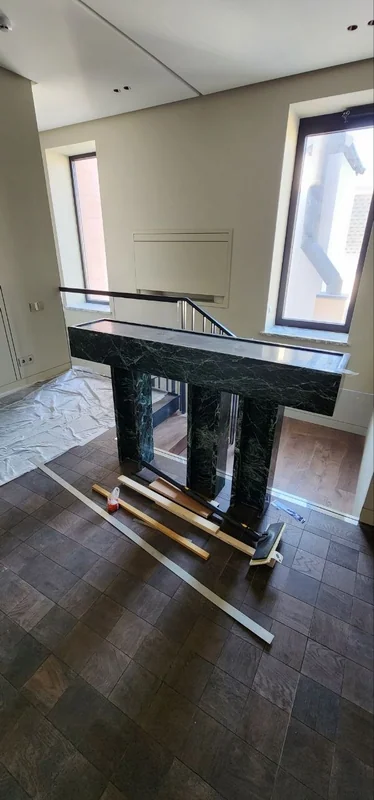
Roughly ten to sixteen weeks for an average flat of 70–100 m², depending on size and on whether the layout changes. Made-to-measure joinery and major-works licences can add to it. The order is not negotiable — each phase has to dry or be certified before the next one starts.
We measure the flat, test what is behind the walls where we can, and draw the layout you want. Out of that comes a fixed quote itemised by trade. Free, anywhere in Catalonia, and no obligation.
We file the comunicado or licence application and, where the work touches the building, put the request to the comunidad. This runs in parallel so it does not add to your timeline.
Floors, tiling, partitions, old bathrooms and kitchen out, skips booked and permits for them obtained. The flat is emptied to structure.
New supply and waste runs, new consumer unit and circuits, extraction. This is the phase that gets certified — you receive the electrical boletín at the end of it, which you will need to put the flat on the market or let it.
The new layout goes up, services are chased in, floors are levelled and walls are made good. Then everything has to dry, and no amount of pressure changes how long that takes.
Doors, wardrobes, skirting, two coats of paint, sockets and switches, light fittings, silicone.
We walk the flat with you and write the snag list down. Certificates and a written warranty are handed over on completion, not promised for later.
We come to the property, measure it and talk through what you want. If you are not in Spain, we arrange the visit with whoever holds the keys and follow up with photographs and measurements.
Itemised by trade, with quality levels named and VAT shown separately. The number does not move unless you change the scope or something genuinely hidden turns up — and then you see the variation in writing before we do it.
One person coordinates every trade and sends you progress photos as the work moves on. You are not managing subcontractors from another country.
Electrical certificate and a written warranty on the work. Where you need a habitability certificate or an energy performance certificate to let or sell, we arrange it.
Survey, quote, variations, progress updates and handover all in English. Nothing important reaches you only as a Spanish PDF you have to decode.
Survey, quote, approvals and progress reports can all run remotely, as photographs, video and written decisions by email. You are needed for little more than the final material choices.
We carry the coordination risk. If the tiler is late the plumber still turns up on the right day, and that is our problem to solve, not yours.
Fixed, itemised, VAT broken out. Hidden conditions behind a wall get priced as a written variation you approve — never added quietly to the final invoice.
Electrical boletín, habitability and energy certificates where needed. These are what a notary, a letting agent or a buyer will ask you for.
A written warranty on the work, documented at handover.
Indicative market ranges per square metre of floor area, VAT excluded. The final price is a fixed quote after the survey.
| Specification | What it covers | Per m² (excl. VAT) | |
|---|---|---|---|
| Functional | Standard finishes, practical solution | 520 – 650 €/m² | |
| Mid-range | Selected materials, best balance | 750 – 940 €/m² | |
| High specification / luxury | Premium materials and high-end interior design | 1,060 – 1,340 €/m² |
Indicative only. VAT excluded. The final figure is a fixed written quote after the free survey.
Full renovation of the whole property, from functional to mid-range specification, VAT excluded.
One bathroom, one kitchen. The price per square metre is higher in a small home, because the kitchen and bathroom cost almost the same whether the flat is 45 or 90 m².
The most usual size, with a kitchen, one or two bathrooms and a new layout. This is the size where opening the kitchen into the living room pays off most.
More floor and wall surface to finish and, often, two full bathrooms. Worth checking the riser capacity before planning a second wet room away from the first.
Large flats and houses. The budget depends heavily on specification and layout, and heating and cooling become a real design decision.
These figures assume the structure is sound. If the survey finds damp, aluminosis-affected concrete or a roof at the end of its life, that is a separate priced item and we will tell you before you commit, not halfway through. Damp treatment and façade work are quoted on their own.
The scope of a turnkey full renovation, and the things that genuinely sit outside it.
VAT is shown as its own line: 10% where the property is a home at least two years old, 21% where it is not, or on work billed to a company. If you are buying the flat and renovating it before you move in, the dates matter — tell us the completion date and we will tell you which rate applies.
A full renovation covers most of this list at once, but each piece can also be done on its own.
Barcelona and all four Catalan provinces. Find your town on the map.
Official boundary data for comarques and municipalities (ICGC, 2025).
The questions we actually get asked about renovating a home in Catalonia from abroad.
As a guide, 520 to 650 €/m² for a functional specification, 750 to 940 €/m² for mid-range and 1,060 to 1,340 €/m² for high specification or luxury, all excluding VAT. A renovation of an 80–100 m² home typically lands between 41,300 and 103,000 €. What moves a job within a band is scope more than taste: how many wet rooms there are, whether they move, whether the layout changes. After the survey the quote is fixed and itemised, so you can see which of those is costing you the money.
Yes. You need a Spanish tax number (NIE) and a Spanish bank account to pay invoices cleanly, both of which you will already have if you bought the property. From there the job runs on regular photographs and written approvals by email. What you cannot do remotely is make the final material choices well — tile and worktop samples look nothing like their photographs — so we either post samples to you or hold those decisions for a single visit.
Ten to sixteen weeks on site for an average flat of 70–100 m², plus time beforehand for drawings, permits and ordering. The fixed points are curing times: screeds and plaster need days to dry regardless of how many people are on site, and a made-to-measure worktop is templated only once the units are standing. Permits can add time too, and that part is the council’s pace, not ours. You get a written programme before we start.
For work inside your own flat that does not touch the building, no — you notify them as a courtesy and get on with it. You do need the comunidad’s agreement when the work affects anything shared: the façade, the roof, a communal patio, the risers, or anything that changes the look of the building from outside. Enclosing a balcony and fitting an external air-conditioning unit are the two that catch people out. We put the request in and tell you honestly how likely it is to pass.
It is the certificate that says a dwelling is legally fit to live in, and in Catalonia you need a current one to let a property or to complete a sale. A renovation does not automatically invalidate it, but if you change the number of rooms, convert a space that was not a dwelling, or alter ventilation and natural light, you will need it re-issued. We arrange it; see habitability certificates.
It is 10% when the work is a renovation of a dwelling that was built and occupied at least two years ago, is billed to a private individual, and the materials we supply come to no more than 40% of the total. It is 21% when any of those fail — a newly built property, work billed to a company, or a job that is mostly materials. The split is not our discretion, it is the rule, and we show the rate as its own line on every quote so you can see which one we have applied and why.
We price it as a written variation and you approve it before we carry on. Three things commonly found in older Barcelona flats are lead supply pipes, wiring with no earth, and damp coming from a neighbour or a communal riser. Our quotes assume you will want the first two replaced, because once the wall is open it is cheap, and name it explicitly. The third one we have to open the wall to see, so it is listed as a risk, not a price, until we know.
Yes, and it tends to work well. We build to their drawings, flag anything that will not work on site before it becomes expensive, and keep one site manager as their point of contact. If you would rather we did the design too, we have an interior design team, and project management on its own if you have trades already.
In stages tied to work you can see: a deposit on signing, payments on completed phases, and the final payment at handover. Never the whole amount up front, and never a payment for a phase that has not happened. Every stage is invoiced properly with VAT shown, which is also what you need if you ever want to prove the cost of the improvement against a future capital gain.
On kitchens, bathrooms and anything that fixes a defect, usually yes in the Barcelona market. On very personal high-end finishes, usually not — you buy those to live with, not to resell. The reliable value is in the parts buyers and surveyors check: working services, a current energy certificate, no damp, and a layout that makes sense. We will say so if what you are asking for is a lifestyle choice rather than an investment.
Practical guides to prices, materials, permits and the decisions that come up on site — so you can plan your flat refurbishment with your eyes open.
10,000 € buys a bathroom or a kitchen; a 60 m² flat starts at 34,400 € at functional level. What each budget covers up to 150,000 €, before VAT.
Read the article →Guides and adviceWhat a technical architect (aparejador) charges in Spain in 2026: fee percentages, fixed prices, what drives the cost and when hiring one is compulsory.
Read the article →Full renovationsWhat an architect charges for a renovation in 2026: typical rates, fees as a share of the PEM budget and how to keep the total under control.
Read the article →Free survey anywhere in Catalonia, in English, and a fixed written quote. We reply within 24 hours.

