A complete refurbishment of a 100 m² masía — the traditional Catalan stone farmhouse — runs between 71,500 and 92,500 € at a functional specification, between 117,000 and 152,000 € at mid-range and between 184,500 and 239,000 € for high specification. Always excluding VAT. These figures are built item by item: the standard trades come from our own price table, and the masía-specific work — consolidating stone walls, autonomous sewage treatment, technical fees — from 2026 market ranges, because we have not yet closed a masía of our own to test them against. At 100 m² the square metre comes out expensive: the roof, the septic tank and the project cost almost the same as in a masía of double the floor area, and here they are spread over half the metres.
Standard finishes, layout unchanged
Selected materials, possible re-planning
Premium materials and interior design
Indicative prices · VAT not included · not a binding offer. Your exact figure comes from the free site visit, fixed and itemised.
A masía is not renovated, it is rehabilitated: the building has stood for between one and three hundred years, several generations have altered it and almost nothing conforms to a standard measurement. That changes the budget in one specific direction — the heavy work rules and finishes weigh less — and it changes the method: first you diagnose, then you design and only then do you put a price on it.
The figures on this page are an item-by-item construction for a masía of 100 m² built over two floors, with a pitched roof and rubble-masonry walls. If your masía has annexes, a threshing floor, a hayloft or a third storey under the roof, the floor area to be rehabilitated is larger than the one the land registry gives as dwelling. We work across the whole of Catalonia, and masía renovation is concentrated in the Vallès and the inland comarcas.
Excluding VAT. The standard trades come from our price table, built from 24 of our closed quotes; the masía-specific items — stone walls, autonomous sewage treatment, technical fees and charges — from 2026 market ranges. It is an indicative construction, not a quote: on a masía the real number comes out of the pathology report.
| Item | Functional | Mid-range | High spec | % of total |
|---|---|---|---|---|
| Demolition and lifting of flooring | 1,400 € | 1,900 € | 3,600 € | 1% |
| Rubble and waste removal · 38 m³ — a masía produces twice as much as a flat | 1,064 € | 1,558 € | 2,470 € | 1% |
| Consolidating and repointing stone walls · 150 m² of wall — the item that does not exist in a flat | 8,250 € | 14,250 € | 22,500 € | 11% |
| Structure: floors and reinforcement · 45 m² of floor; in a masía there is almost always timber to replace | 900 € | 3,015 € | 5,265 € | 2% |
| Roof (complete refurbishment) · 55 m² of pitch | 5,335 € | 9,130 € | 12,210 € | 7% |
| Waterproofing | 616 € | 1,892 € | 2,112 € | 1% |
| Façade: render and finish · 130 m² on four faces, not one | 3,640 € | 5,980 € | 12,480 € | 4% |
| Thermal and acoustic insulation | 1,800 € | 2,200 € | 2,400 € | 2% |
| Complete electrical installation | 3,793 € | 3,867 € | 3,976 € | 3% |
| Plumbing and drainage · 10 points | 2,600 € | 3,640 € | 5,110 € | 3% |
| Autonomous sewage treatment (septic tank or plant) · if there is no municipal network, which is the norm | 3,000 € | 5,000 € | 8,000 € | 4% |
| Heating (underfloor + generation) · a masía almost never comes with usable heating | 5,500 € | 7,500 € | 10,000 € | 6% |
| Exterior joinery · 10 openings, many of non-standard size | 5,530 € | 11,500 € | 22,160 € | 9% |
| Internal joinery · 8 doors | 2,000 € | 4,600 € | 6,240 € | 3% |
| Building work: renders and bases | 3,600 € | 3,600 € | 3,800 € | 3% |
| Interior flooring | 2,700 € | 4,000 € | 7,300 € | 3% |
| Complete bathrooms · 1 bathroom(s) | 10,255 € | 15,759 € | 20,467 € | 12% |
| Complete kitchen | 5,518 € | 7,650 € | 14,961 € | 6% |
| Skimming and painting · wall and ceiling surface, not floor | 3,600 € | 5,760 € | 6,000 € | 4% |
| Access equipment, scaffolding and protection | 906 € | 1,020 € | 1,422 € | 1% |
| Building labourers’ assistance | 960 € | 1,197 € | 1,923 € | 1% |
| Preliminary pathology study · compulsory in practice for a masía | 1,500 € | 2,600 € | 4,000 € | 2% |
| Project and technical supervision · 8-14% of the PEM (material execution budget); a masía always needs a project | 5,837 € | 12,652 € | 24,415 € | 10% |
| Fees and major-works licence · 1-4% depending on the municipality | 730 € | 2,875 € | 6,976 € | 2% |
| Total for the example budget | 81,034 € | 133,145 € | 209,787 € | |
| Equivalent per m² | 810 €/m² | 1,331 €/m² | 2,098 €/m² |
A masía does not get dearer by the metre, it gets dearer by the building. Autonomous sewage treatment costs the same for 100 as for 300 m². The pathology study, likewise. The project and technical supervision are calculated on the budget, but they have a floor below which no technician signs. And the roof, which is the queen item, depends on the area of the pitch, not on the habitable metres: a two-storey masía of 100 m² built has practically the same roof as one of 110.
Added together, those start-up items take a share of a 100 m² budget that in a 300 m² one is barely noticed. It is the same effect that explains why renovating a 50 m² flat costs more per metre than a 90 m² one, only in a masía the step is much higher.
We say it here and not in the small print: we have not yet delivered a masía of our own. On the rest of this site’s price pages you will see two of our jobs with their photos and real cost; on these four there are none, because we do not have them, and putting a renovated flat in their place would be selling you an experience the photos do not support.
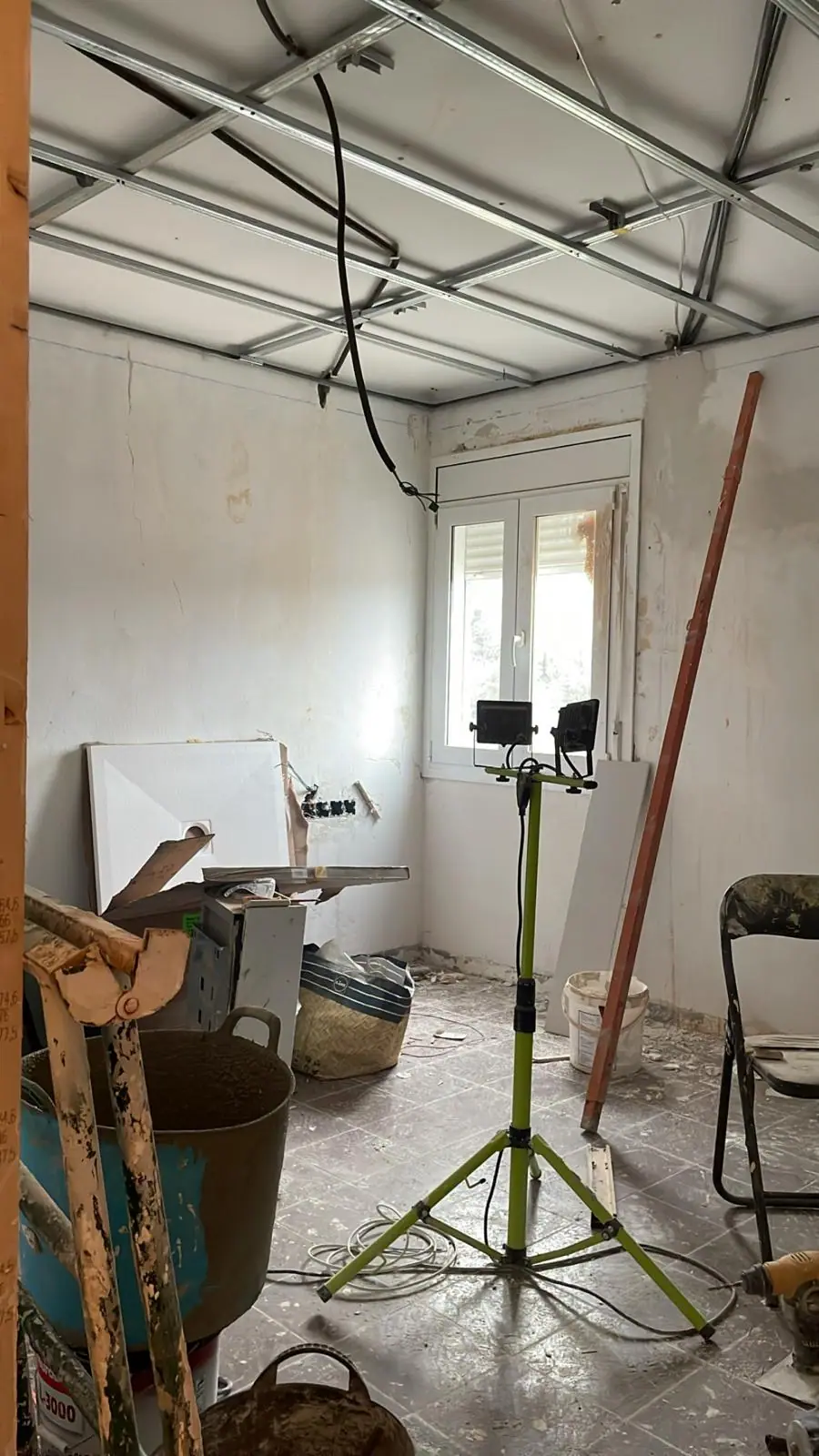
What we have done is the heavy work that rules in a masía. In our refurbishment of a building in Santa Coloma we rebuilt floors, fitted a new steel structure and worked on two levels with the building open: these are exactly the items that take a quarter of the budget in this table. The photos on this page come from that job, and each caption says where it comes from.
For the rest, the honest answer is a visit. On a masía no serious company gives you a number over the phone: someone goes up on the roof, trial openings are made and a pathology report is written. That report costs between 1,500 and 4,000 € and is the only thing that turns the figures above into a quote. If you are weighing up a purchase, ask for it before signing, not after.
In urban land you take for granted that there is a water connection, power and sewerage. In a masía it is normal for one of the three to be missing, and that is not a building item: it is a negotiation with a utility company or the council, with its own timescales and its own bill.
Sewerage. With no municipal network you need a septic tank or a compact treatment plant. It is in the table below because it is practically certain, but the price depends on the terrain and on the number of equivalent inhabitants the project declares.
Water. Your own well with its pump and treatment, or a connection from the nearest point, paid by the metre of trench. Power. If the line is far, the extension is charged by the distributor and can exceed any item on this page; the alternative is an off-grid installation with solar and batteries.
None of the three can be estimated without seeing the property. They are the main reason a masía is not priced over the phone.
Survey, trial openings and a pathology report; without this any figure is a round number
Signing-off, submission to the council and, if listed, a heritage report
Perimeter scaffolding, stockpiles, removal of whatever is not kept
The phase that stops the deterioration: floors, trusses, insulation and waterproofing
Electrics, plumbing, autonomous sewage treatment, heating and exterior joinery
Flooring, tiling, bathrooms, kitchen, painting and internal joinery
24–34 weeks — A complete 100 m² refurbishment takes the building time the table above implies, but what throws almost everyone is what comes before: between the pathology study, the project and the major-works licence, three to nine months pass before anyone enters the property. Count that stretch from the start.
Licence and procedures. Major works, always: a project drafted by a competent technician, technical supervision, a health-and-safety study and council charges, which in Catalonia run from 1 to 4% of the execution budget depending on the municipality. If the masía is on the register of protected buildings, the file also goes through heritage and adds months. All of that is in the breakdown above, not hidden in the small print.
Not every cut has the same effect: these are the items where saving is sensible, and the ones where it ends up costing more.
Functional and mid-range ranges, excluding VAT. The price per metre falls with floor area because the start-up items do not grow.
| Floor area | Functional | Mid-range |
|---|---|---|
| 150 m² masía | 102,000 – 132,000 € | 169,000 – 218,500 € |
| 200 m² masía | 123,000 – 159,500 € | 204,500 – 265,000 € |
| 300 m² masía | 174,000 – 225,000 € | 290,500 – 376,500 € |
| 150 m² house (no stone walls) | — | See page |
* Indicative prices, excluding VAT. They vary with the starting condition of the home, the municipality and the finishes chosen.
The ones we are asked most before a quote is signed.
Yes, if the structure and roof are sound and you work at a functional specification. What almost never fits in that figure is a masía that has been unused for years: there the floors, roof and sewage treatment eat the budget before you reach the finishes. The pathology study, which is 1,500–4,000 €, is what separates one case from the other, and it is money well spent before buying.
For a complete refurbishment, yes. It is processed as major works and requires a project and technical supervision, which is the “project and supervision” item in the table. If the masía is listed, there is also a heritage report from the council or the comarca.
A septic tank or compact treatment plant, sized by the project according to equivalent inhabitants. It is included in the breakdown. What cannot be taken for granted is water and power: those depend on the distance to the supply point and are priced separately, once the property has been seen.
Sometimes it comes out cheaper on site, but with a masía it is rarely possible: many are on non-developable land, where the rules allow rehabilitating what exists and not erecting new buildings. The volume you have is the volume you can keep, which is why rehabilitation is the route, not the alternative.
Full renovations in Barcelona and across Catalonia. A fixed, itemised quote, a dedicated site manager who keeps you informed and a written warranty.
A free site visit, a fixed itemised quote and a written programme. What we sign is what you pay.

