A complete refurbishment of a 300 m² masía — the traditional Catalan stone farmhouse — runs between 174,000 and 225,000 € at a functional specification, between 290,500 and 376,500 € at mid-range and between 450,500 and 583,500 € for high specification. Always excluding VAT. These figures are built item by item: the standard trades come from our own price table, and the masía-specific work — consolidating stone walls, autonomous sewage treatment, technical fees — from 2026 market ranges, because we have not yet closed a masía of our own to test them against. At this size it is no longer a renovation: it is a multi-year project, with a major-works licence always, technical supervision throughout and a calendar measured in years, not months.
Standard finishes, layout unchanged
Selected materials, possible re-planning
Premium materials and interior design
Indicative prices · VAT not included · not a binding offer. Your exact figure comes from the free site visit, fixed and itemised.
A masía is not renovated, it is rehabilitated: the building has stood for between one and three hundred years, several generations have altered it and almost nothing conforms to a standard measurement. That changes the budget in one specific direction — the heavy work rules and finishes weigh less — and it changes the method: first you diagnose, then you design and only then do you put a price on it.
The figures on this page are an item-by-item construction for a masía of 300 m² built over two floors, with a pitched roof and rubble-masonry walls. If your masía has annexes, a threshing floor, a hayloft or a third storey under the roof, the floor area to be rehabilitated is larger than the one the land registry gives as dwelling. We work across the whole of Catalonia, and masía renovation is concentrated in the Vallès and the inland comarcas.
Excluding VAT. The standard trades come from our price table, built from 24 of our closed quotes; the masía-specific items — stone walls, autonomous sewage treatment, technical fees and charges — from 2026 market ranges. It is an indicative construction, not a quote: on a masía the real number comes out of the pathology report.
| Item | Functional | Mid-range | High spec | % of total |
|---|---|---|---|---|
| Demolition and lifting of flooring | 4,200 € | 5,700 € | 10,800 € | 2% |
| Rubble and waste removal · 105 m³ — a masía produces twice as much as a flat | 2,940 € | 4,305 € | 6,825 € | 1% |
| Consolidating and repointing stone walls · 400 m² of wall — the item that does not exist in a flat | 22,000 € | 38,000 € | 60,000 € | 12% |
| Structure: floors and reinforcement · 145 m² of floor; in a masía there is almost always timber to replace | 2,900 € | 9,715 € | 16,965 € | 3% |
| Roof (complete refurbishment) · 155 m² of pitch | 15,035 € | 25,730 € | 34,410 € | 8% |
| Waterproofing | 1,736 € | 5,332 € | 5,952 € | 2% |
| Façade: render and finish · 300 m² on four faces, not one | 8,400 € | 13,800 € | 28,800 € | 4% |
| Thermal and acoustic insulation | 5,400 € | 6,600 € | 7,200 € | 2% |
| Complete electrical installation | 3,793 € | 3,867 € | 3,976 € | 1% |
| Plumbing and drainage · 26 points | 6,760 € | 9,464 € | 13,286 € | 3% |
| Autonomous sewage treatment (septic tank or plant) · if there is no municipal network, which is the norm | 3,000 € | 5,000 € | 8,000 € | 2% |
| Heating (underfloor + generation) · a masía almost never comes with usable heating | 16,500 € | 22,500 € | 30,000 € | 7% |
| Exterior joinery · 26 openings, many of non-standard size | 14,378 € | 29,900 € | 57,616 € | 9% |
| Internal joinery · 20 doors | 5,000 € | 11,500 € | 15,600 € | 3% |
| Building work: renders and bases | 10,800 € | 10,800 € | 11,400 € | 3% |
| Interior flooring | 8,100 € | 12,000 € | 21,900 € | 4% |
| Complete bathrooms · 3 bathroom(s) | 30,765 € | 47,277 € | 61,401 € | 14% |
| Complete kitchen | 5,518 € | 7,650 € | 14,961 € | 2% |
| Skimming and painting · wall and ceiling surface, not floor | 10,800 € | 17,280 € | 18,000 € | 5% |
| Access equipment, scaffolding and protection | 906 € | 1,020 € | 1,422 € | 0% |
| Building labourers’ assistance | 960 € | 1,197 € | 1,923 € | 0% |
| Preliminary pathology study · compulsory in practice for a masía | 1,500 € | 2,600 € | 4,000 € | 1% |
| Project and technical supervision · 8-14% of the PEM (material execution budget); a masía always needs a project | 14,391 € | 31,750 € | 60,261 € | 10% |
| Fees and major-works licence · 1-4% depending on the municipality | 1,799 € | 7,216 € | 17,217 € | 2% |
| Total for the example budget | 197,581 € | 330,203 € | 511,915 € | |
| Equivalent per m² | 659 €/m² | 1,101 €/m² | 1,706 €/m² |
At 300 m² the square metre is the cheapest of the four pages — the start-up items are spread over three times the floor area of a 100 m² masía — and yet it is the hardest job to manage. The problem stops being the unit price and becomes the calendar and price revision.
A job of two or three years cannot be contracted at a fixed price from start to finish without somebody taking a risk they do not control: the client should not pay in advance for an inflation that may not arrive, nor can the company sustain year-three prices at year-one levels. The sensible thing is to contract in phases with a fixed price per phase, with the complete project drafted from the start so that the phases fit together.
That demands something that is not free: a complete executive project before starting, not a preliminary design. It costs more at the beginning and it is the only thing that stops phase three discovering that phase one let a downpipe go by. It is the same principle as in a 300 m² detached house, but with one more layer of uncertainty: in a masía, the real state of what exists is only known by opening it.
We say it here and not in the small print: we have not yet delivered a masía of our own. On the rest of this site’s price pages you will see two of our jobs with their photos and real cost; on these four there are none, because we do not have them, and putting a renovated flat in their place would be selling you an experience the photos do not support.
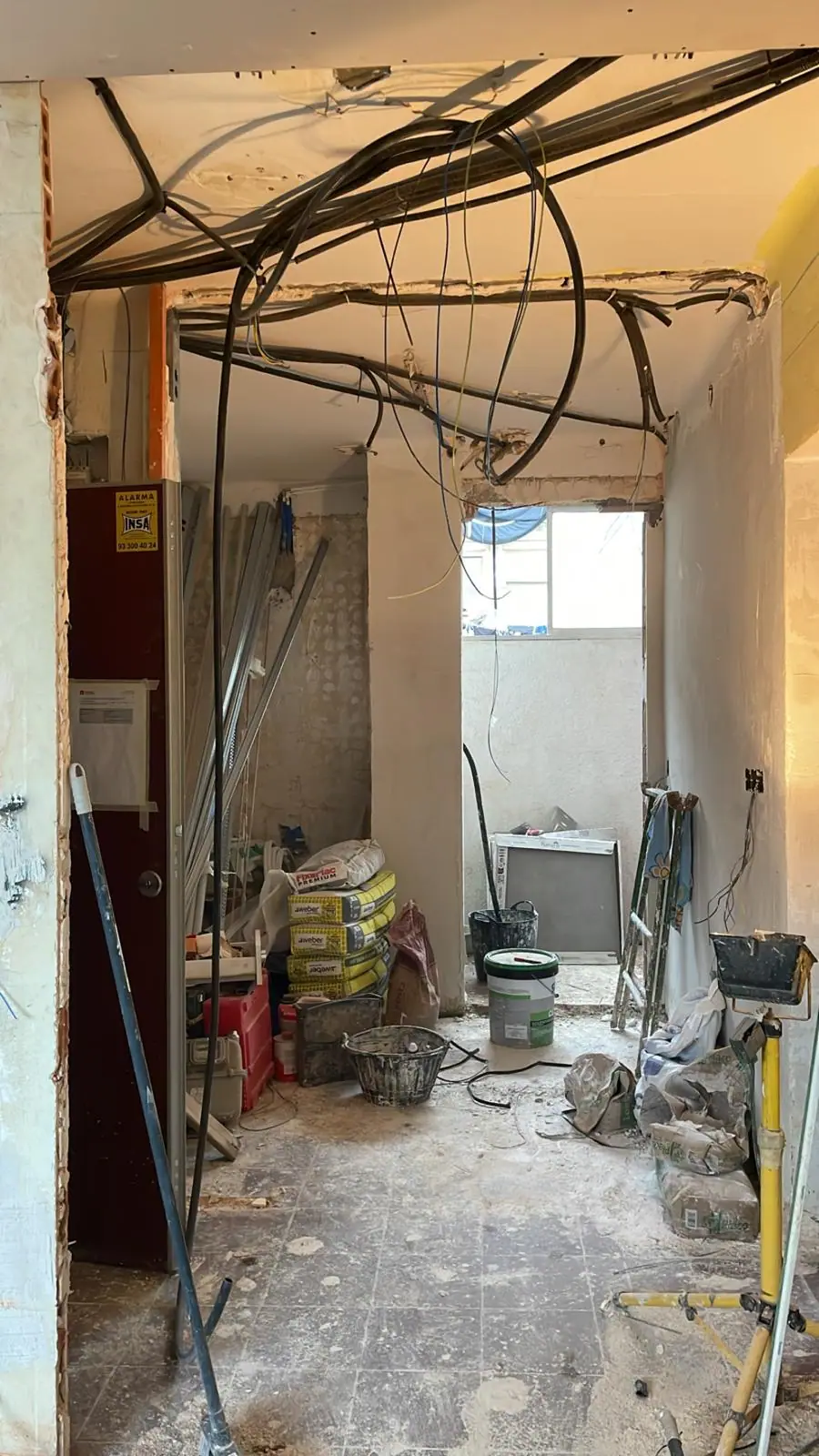
What we have done is the heavy work that rules in a masía. In our refurbishment of a building in Santa Coloma we rebuilt floors, fitted a new steel structure and worked on two levels with the building open: these are exactly the items that take a quarter of the budget in this table. The photos on this page come from that job, and each caption says where it comes from.
For the rest, the honest answer is a visit. On a masía no serious company gives you a number over the phone: someone goes up on the roof, trial openings are made and a pathology report is written. That report costs between 1,500 and 4,000 € and is the only thing that turns the figures above into a quote. If you are weighing up a purchase, ask for it before signing, not after.
The contract for a 300 m² masía has little in common with that of a flat renovation. There are three clauses that matter, and none has anything to do with materials.
Fixed price per phase. Each phase is priced and signed separately, with its own scope and timescale. The overall budget exists as a framework, but what binds is the phase under way. Written price revision. If more than twelve months pass between phases, the contract must say how prices are updated: with a public index, not “to be agreed”. Pause conditions. What happens if you decide to stop for a year: who looks after what has been built, who answers for whatever deteriorates and how it is restarted.
And a fourth that is common sense: the technical supervision must be the same from start to finish. Changing technician between phases on a three-year job is the surest way of losing track of what was done and why.
Survey, trial openings and a pathology report; without this any figure is a round number
Signing-off, submission to the council and, if listed, a heritage report
Perimeter scaffolding, stockpiles, removal of whatever is not kept
The phase that stops the deterioration: floors, trusses, insulation and waterproofing
Electrics, plumbing, autonomous sewage treatment, heating and exterior joinery
Flooring, tiling, bathrooms, kitchen, painting and internal joinery
18–30 months — A complete 300 m² refurbishment takes the building time the table above implies, but what throws almost everyone is what comes before: between the pathology study, the project and the major-works licence, three to nine months pass before anyone enters the property. Count that stretch from the start.
Licence and procedures. Major works, always: a project drafted by a competent technician, technical supervision, a health-and-safety study and council charges, which in Catalonia run from 1 to 4% of the execution budget depending on the municipality. If the masía is on the register of protected buildings, the file also goes through heritage and adds months. All of that is in the breakdown above, not hidden in the small print.
Not every cut has the same effect: these are the items where saving is sensible, and the ones where it ends up costing more.
Functional and mid-range ranges, excluding VAT. The price per metre falls with floor area because the start-up items do not grow.
| Floor area | Functional | Mid-range |
|---|---|---|
| 100 m² masía | 71,500 – 92,500 € | 117,000 – 152,000 € |
| 150 m² masía | 102,000 – 132,000 € | 169,000 – 218,500 € |
| 200 m² masía | 123,000 – 159,500 € | 204,500 – 265,000 € |
| 150 m² house (no stone walls) | — | See page |
* Indicative prices, excluding VAT. They vary with the starting condition of the home, the municipality and the finishes chosen.
The ones we are asked most before a quote is signed.
In one go, between 18 and 30 months of work, plus the preliminary procedures. In phases, it is measured in years and your calendar sets it, not ours. In both cases you have to add between three and nine months of project and licence before anyone starts work on site.
Because the start-up items — autonomous sewage treatment, pathology study, project, site set-up — hardly grow with floor area, and at 300 m² they are spread over three times the metres. The price per metre falls; the total, obviously, does not.
It can, but two or three years out nobody can hold the initial price without inflating it to cover themselves. It works out better to close by phases and write down how prices are revised between one and the next. What must be closed from day one is the project.
Always, at this size and with this scope. Project, technical supervision, health-and-safety study and council charges, which are in the breakdown. If it is also listed, add the heritage procedure.
Full renovations in Barcelona and across Catalonia. A fixed, itemised quote, a dedicated site manager who keeps you informed and a written warranty.
A free site visit, a fixed itemised quote and a written programme. What we sign is what you pay.

