Building work in Barcelona, hired on its own: partitions, demolition, hacking off, screeds and finishing in flats and old buildings, with the community, rubble and permits each job requires.
When you call a bricklayer in Barcelona without wanting a whole renovation, you tend to ask for very specific things: take down a partition, close a doorway, hack off a salt-damaged render, build up a floor to level it or redo the finishes after a leak. It is building work bought as a trade, and it is quoted item by item, not by the flat. Each job has its own scope and price, and you can order just one without dragging in the rest of the works.
The line sits at a very clear point. A hollow-brick or thin-brick partition that only separates rooms is taken down and put up by a skilled bricklayer. A wall that holds up a floor, by contrast, needs a calculated lintel and a technical project, and that is signed by a technician, not a bricklayer. In Barcelona, with so many old buildings with thick walls and joist floors, the doubt is frequent. We check it at the visit, before touching anything.
The same goes for what you cannot see from inside the flat: light wells, party walls, shared downpipes, roofs. Those are common elements and the community decides, not you. A crack crossing the party wall or a damp patch coming from the courtyard is not a stand-alone building job until you know where it comes from. The origin is diagnosed first; then what belongs to the flat is repaired and you are told about what does not.
And then there is the building. Even if the job is small, the community has to be told, the staircase and the lift protected and the rubble taken down in sacks or a skip, which in the street needs a public highway permit. Depending on the scope, the Ajuntament asks for a prior notification or a licence, and we confirm it before starting. A demolition without that paperwork ends in a neighbour’s complaint or a stop-work order.
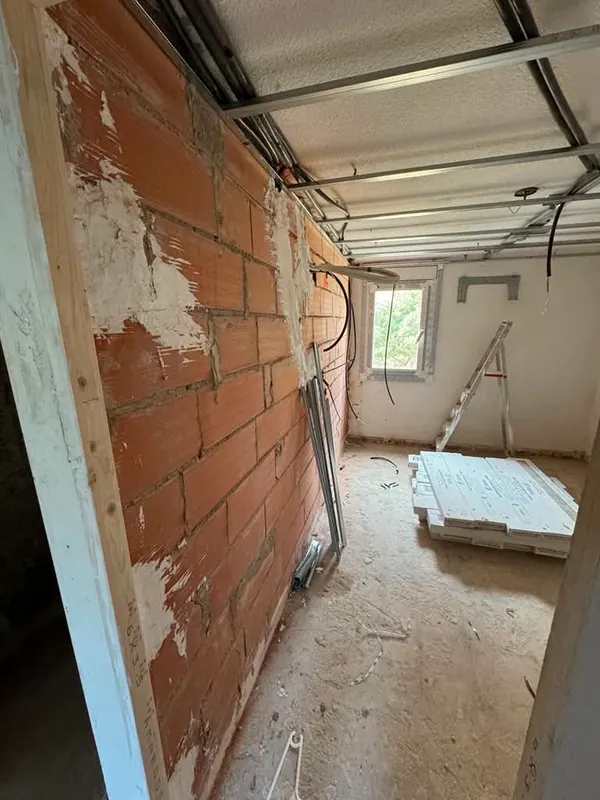
Indicative ranges, VAT excluded.
| Work | What it covers | Indicative range | |
|---|---|---|---|
| Floor / wall tiling | Standard finishes, practical solution | 25 – 50 €/m² | |
| Brick partition | Selected materials, best balance | 30 – 55 €/m² | |
| Individual jobs | Premium materials and high-end interior design | By the job |
Indicative only. VAT excluded. The final figure is a fixed written quote after the free survey.
Indicative ranges, VAT excluded.
Laying floor and wall finishes to a good standard.
Building or taking out partitions and re-planning the layout.
Forming built-in shower bases, screeds and bedding.
Mending partitions, closing openings and small building repairs.
Anything that involves a wall that may be load-bearing needs a technician to confirm it first, and sometimes a permit. See permits and drawings.
The scope of a building job, and what is separate.
VAT is shown as its own line — 10% or 21% depending on your case.
The same team and the same fixed quote, for the rest of the home in Barcelona.
One team for the whole job, in Barcelona and across Catalonia.
Building work in Barcelona: what you really ask before ordering a job.
The quickest is to describe the job and send photographs of the space; then we visit the flat, because seeing the wall, the floor and the access changes the calculation a lot. The quote is broken down item by item, so each job has its own line: partition, hacking off, screed, rubble. That way you can take out an item or order just one from us. You do not have to renovate the whole flat to ask.
The visit to assess the job and the quote are free. As a guide, and excluding VAT, a brick partition runs around 30 to 55 euros per square metre and a floor or wall tiling job between 25 and 50 euros per square metre. They are reference figures, not an offer. The real price depends on access, whether there is a lift, the height and the rubble, and is fixed after seeing the job.
It includes the bricklayer’s labour, the building materials and the removal of the rubble from the job itself. It does not include structural calculation if a load-bearing wall is touched, nor fees or licences, nor the painting afterwards, nor the plumbing or electrical installations if they are separate. What stays out we put in writing in the quote, so there are no surprises halfway through.
Only if it is a partition that holds nothing up. To know, we look at the thickness, the material, which way the joists bear and what is above. If it turns out to be load-bearing, you need a calculated lintel and a project from a technician. In old buildings that is more common than it seems, which is why none is taken down without checking first.
Those that affect the structure: opening or enlarging a doorway in a load-bearing wall, removing a column, altering a floor or changing the layout of a main wall. Also anything that touches the façade or a common element. Non-load-bearing partitions, hacking off, rendering, screeds or finishing do not need it, and are done with a bricklayer and the works permits that apply.
Yes, it is always advisable. Even for a single partition there is noise, dust, material coming and going and rubble on the stairs or in the lift. We notify the community with the dates, agree hours, protect common areas and, if the rubble goes down to a skip in the street, we handle the public highway permit. It is the way to avoid complaints and stoppages.
Yes, the building part: hacking off the damaged render, letting it dry, redoing the wall finish and the touch-ups. Before that the leak has to be located and cut off; if the source is a shared downpipe or the courtyard, it is a matter for the community and we tell you so. Repairing the finish without resolving the cause only delays the problem by a few months.
Practical guides to prices, materials, permits and the decisions that come up on site — so you can plan your flat refurbishment with your eyes open.
10,000 € buys a bathroom or a kitchen; a 60 m² flat starts at 34,400 € at functional level. What each budget covers up to 150,000 €, before VAT.
Read the article →Guides and adviceWhat a technical architect (aparejador) charges in Spain in 2026: fee percentages, fixed prices, what drives the cost and when hiring one is compulsory.
Read the article →Full renovationsWhat an architect charges for a renovation in 2026: typical rates, fees as a share of the PEM budget and how to keep the total under control.
Read the article →Free survey anywhere in Catalonia. A fixed price per square metre or per item.

