

Cracks in walls and ceilings: which ones matter and which don't (partition vs structure)
How to classify a crack by appearance, position and movement, monitor it at home with a method, and know when to call a competent technician.
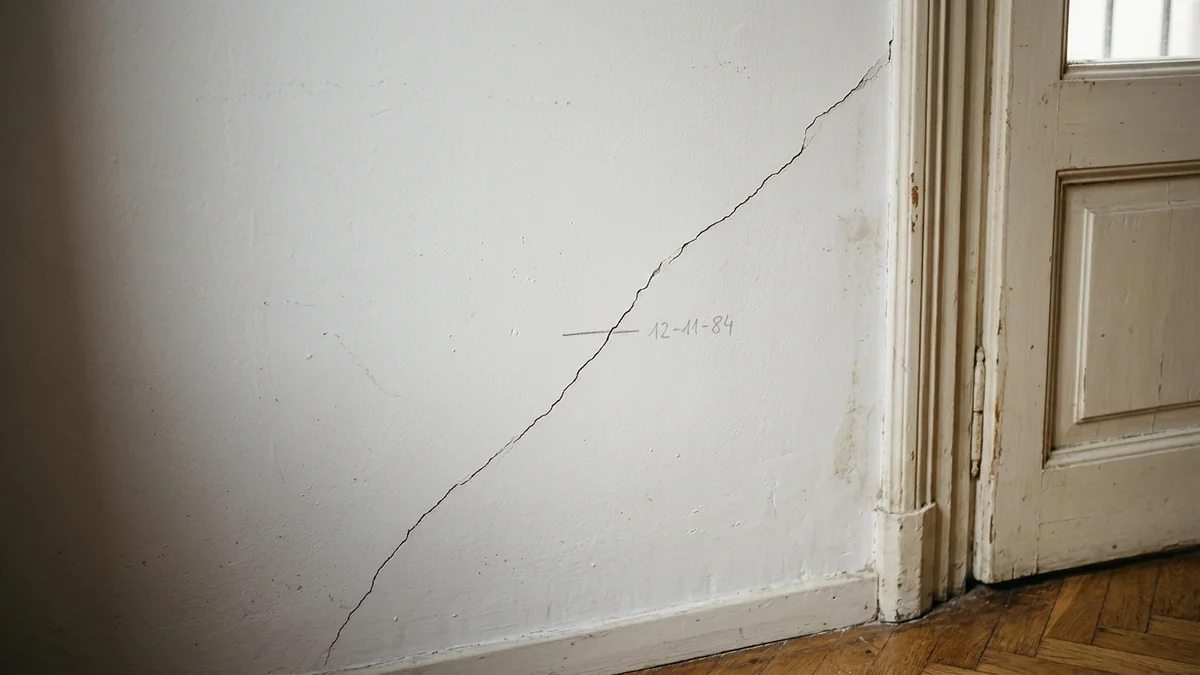
When should you worry about a crack in a wall?
A crack in a wall is a real concern when it is diagonal and starts at the corner of a door or window, when it is horizontal, when it runs across the wall from side to side or when it grows over time. A thin crack in paint, in a joint or where two materials meet almost never is. In any of the serious cases you need a competent technician, an architect or technical architect (arquitecto técnico), to see it in person.
Key points
- A crack is classified by three things: appearance, position and movement. A close-up photo gives you none of the three.
- Thin cracks at joints between different materials or in the paint are usually cosmetic, not structural.
- Diagonals from an opening, horizontal cracks and those that cross the whole wall should be watched closely and shown to a technician.
- A dated mark and a photo with a reference are worth more than any improvised measurement.
- Before repairing, have a technician look at it: covering a crack without knowing why it opened hides it, it does not solve it.
First look at what type of crack it is: appearance, position and length
Three questions sort almost any crack: what it looks like, where it is and whether it moves. That separates the cosmetic from what deserves a technical visit.
The appearance tells the story of the material. A very thin line that only breaks the paint is one thing. An opening with uneven edges, where one side stands proud of the other, is very different. If you can also see the brick or plaster inside, the crack is no longer just on the surface.
The position tells you what is working. A crack at the join between wall and ceiling, or between a partition and a pillar, usually marks where two materials meet. A crack that starts at the corner of a window points to something else. Direction matters too: vertical, horizontal and diagonal do not mean the same thing.
Movement is the most underestimated. An old, stable crack full of dust and layers of paint is not the same as one that appeared two months ago and is longer today. That is why nobody should diagnose anything by looking at a single moment.
A serious warning: you will not find width thresholds in millimetres here as a rule. A loose number in a text does not replace a technician who walks the whole wall, sees the building and understands how it carries load.
On visits, almost the same thing happens every time. When an owner calls us about a crack, they arrive with a close-up photo and the worst theory in mind. Most turn out to be a joint between different materials. The few that are not are recognised quickly because they run a long way, and that cannot be seen in a photo: you see it by following the whole wall.
The ones that rarely matter: cracks in paint, joints and where materials meet
Surface cracks are the most common and, in general, the least serious. They appear because of how a building is made and painted, not because it is moving.
The most typical one follows the join between two different materials: a brick partition against a concrete pillar, a plasterboard sheet against a masonry wall, or plaster against the skirting board. Each material expands and contracts at its own rate with heat, cold and humidity, so the joint gives a little. It is a straight line, almost always following the meeting point exactly.
In plasterboard, the joints between sheets can show if the tape or filler was not done well. A straight line appears that repeats the layout of the sheets. That kind of crack is a finishing defect and is repaired in the finish.
There are also shrinkage cracks in the plaster or paint: a network of very fine lines, sometimes web-shaped, that only affect the finish layer. They appear mostly when it was applied too thick or in a hurry, and are fixed with the appropriate surface repair.
Even so, "rarely a concern" does not mean "never". If one of these cracks starts to widen, lengthen or appears with stains, the pattern changes. If there is a damp stain, mould or corners that smell, the cause may not be material movement but water, and then the crack is only the symptom.
The ones to watch closely: diagonals at openings, horizontals and cracks across the wall
Three shapes deserve serious attention: the diagonal from an opening, the horizontal and the one that goes through the wall from side to side. None can be diagnosed from home.
The diagonal starting at the corner of a door or window is one of the most typical. Stresses concentrate at those corners, because the opening interrupts the wall. Often it is a settlement crack of no great consequence, but precisely because it is the point where the wall "warns" you, it is the one most worth showing a professional.
The horizontal deserves respect. Walls are designed to carry vertical loads, and a line running horizontally may indicate another kind of thrust or movement. It is no reason to panic, but it is a reason for someone trained to see it before you do anything.
The one that crosses the wall from side to side, from ceiling to floor or from one end to the other, is the one with length. If it also appears at the same point in the next room or the floor above, it needs even closer attention.
There are other signs that add up: a door that suddenly rubs or will not close, a window that sticks, a floor with a new slope, a step between the two sides of the crack. None proves anything on its own, but combined with a growing crack they change the conversation.
And here comes the question of which wall it is. A partition wall is not the same as a load-bearing wall: if you wonder which one you are facing, load-bearing wall and partition are told apart with criteria explained separately. A technician decides it with the building plans, not the thickness or the sound when you knock.
There is also a crack that "breathes": it opens in summer or winter and closes afterwards. This seasonal behaviour is usually linked to the expansion of materials, but following it over time is exactly what lets a technician interpret it. Note it down, do not ignore it.
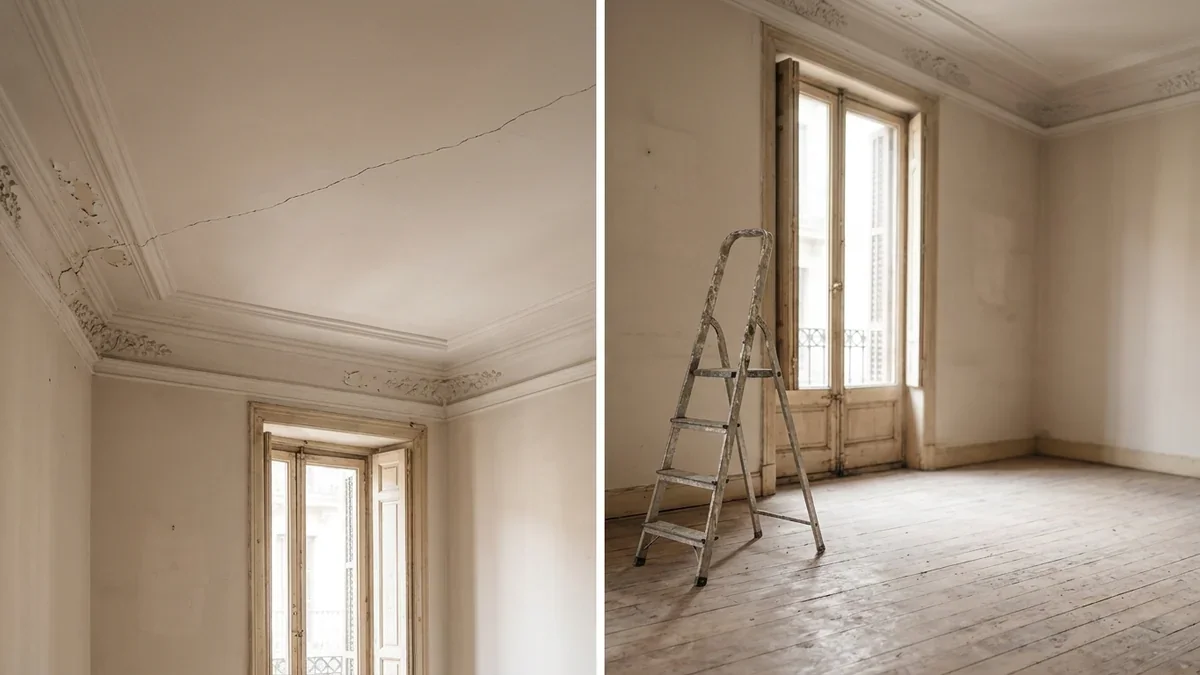
Cracks in the ceiling: what they mean and when the floor slab is checked
A crack in the ceiling is, in most cases, a finishing problem or a problem at the join between elements. The exception is those accompanied by visible sagging or water.
The fine line along the meeting of ceiling and wall, or ceiling and moulding, is very common. In older flats with plaster ceilings and cornices, that join cracks easily because they are different pieces with different behaviour. It is the same principle as in walls: two materials, a joint that gives.
Cracks at the joints between sheets of a plasterboard false ceiling are also common and come from how the joints were done, not from the floor slab.
What you do need to look at differently is a ceiling that looks bowed, with a curve it did not have before, or a crack that follows a long, marked line accompanied by sagging. The same goes when a damp stain appears next to the crack: the priority is to find where the water comes from, because it may be a leak from the flat above or an infiltration. If there are smells near a soil stack, that source should also be ruled out.
When the doubt reaches the floor slab, the criterion is the same as for walls: it is not interpreted from a photo. A competent technician assesses whether it is a finishing issue, a damp issue or something that requires looking at the structure of the slab.
How to monitor a crack at home: dated marks, photos and what to note
Monitoring a crack does not need instruments: it needs method and consistency. What you want is to be able to show, with dates, whether it moves or not.
The simplest method is a dated mark. With a fine pencil, draw a small line across the crack at a specific point and write the date next to it. Do the same at the end where the crack stops. If after a few weeks the crack has gone past the mark, you will see it clearly.
Photos work if they include a reference. Put a ruler or tape measure against the wall next to the crack, and always take the photo from the same spot and in the same light. A photo with nothing for reference does not allow comparison. Repeat from time to time and keep them all together with their dates.
This is what is worth noting:
- Exactly where it is: room, wall and approximate height.
- When you first saw it and whether it coincides with any works, vibration or change in weather.
- Whether it lengthens, widens or appears on another nearby wall.
- Whether there are other symptoms: doors that rub, slopes, stains.
- Whether the crack changes with the seasons.
That monitoring notebook is the most valuable thing you can hand to a technician. It saves time and gives them what is most missing on a first visit: the movement over time.
And a note on cracks after a renovation. If they appear soon after works, do not dismiss them or simply blame the works: they may be simple joints between new and old material, but it is also worth having someone check what was touched. Note it down with the same discipline.
When to call a technician and what to do in the meantime before repairing
Call a technician when the crack meets any of the serious cases: diagonal from an opening, horizontal, side to side or growing. Also if you are in doubt and it will not let you rest. You do not need to wait until you are sure it is serious.
The right professional is an architect or a technical architect (arquitecto técnico), that is, a competent technician in the sense of the Building Act (LOE). They can assess the building, ask for exploratory openings if needed and decide whether monitoring is enough or action is required. If what you need is to prove that the structure is safe, there is a specific document, the soundness certificate, signed by a technician.
In the meantime, the most sensible thing is not to repair. Filling the crack with filler and painting over it hides the information: if it reopens later, you will not know when or how much, and you will have lost your best data. First you understand why it opened; then you repair it.
What you can do: keep up your marks and photos, move heavy furniture away from a suspect wall and tell the technician about any rapid change. And if you notice something that seems urgent, such as a deformation that is advancing, creaking or falling material, do not wait to note anything down: report it immediately.
If you live in an old building and the problem seems to affect more neighbours or common elements, that is another conversation, and it goes to the owners' community. In that case, the building inspection (ITE) is the route for reviewing the state of the building. And if it is a building in the Eixample, pathologies such as those of courtyards and façades have their own particularities.
Once the technician has ruled out a structural problem, the part that is genuinely building work comes: repairing partitions, plastering and joints, which is ordinary masonry. At that point, a fixed quote by item avoids surprises, and the free technical visit is used to see what needs doing on each wall.
Frequently asked questions about cracks in walls and ceilings
Is a diagonal crack in a wall serious?
Not always, but it is one to show a technician. If it starts at the corner of a door or window, or grows over time, an architect or technical architect should see it in person. From a photo you cannot decide whether it is cosmetic or structural.
How do I know if a crack is in a partition or a load-bearing wall?
You cannot tell from the thickness or the sound when you knock. A technician determines it with the building plans and, if needed, exploratory openings. Until then, treat the crack with caution and do no work on that wall.
Can I repair a crack before a technician sees it?
Better not to. Covering the crack with filler and paint erases the information on whether it moves. Have a technician see it first, while you monitor with dated marks and photos; then it is repaired properly.
What does a crack between the wall and the ceiling mean?
Most often it is the joint between two different materials, such as plaster and moulding, which move differently. It is usually a finishing matter. If it appears with a damp stain or a bowed ceiling, a technician should look at it.
Who do I call if I have a crack at home, an architect or a technical architect?
Either of the two: both are competent technicians to assess the building. Take your photos and dated marks, because what helps most is knowing how the crack has changed, not just how it looks today.
Further reading
- Partitions you can remove and walls you cannot: how to identify a load-bearing wall - If the doubt is whether the affected wall is a partition or a load-bearing wall, here is the criterion to tell them apart.
- What is a structural soundness certificate in Spain? - The document a technician signs when you need to prove the structure is safe.
- Common defects in Eixample buildings: ITE, courtyards and façades - If you live in an Eixample building, here are the pathologies typical of those buildings.
- Building inspection (ITE) in Catalonia - When the problem affects the building and not just your home, the ITE is the route for reviewing it.
- Masonry in Barcelona - Repair of partitions, plastering and joints once a technician has ruled out the structural problem.
- Full home renovations in Barcelona for old flats, houses and commercial premises - If the technician confirms the cause is deeper and work is needed across the whole home, here is how that work is approached.
Sources
Keep reading
The technical visit before your renovation quote: what is checked and what to have ready
What the site manager checks in your flat, which papers to bring and which decisions to settle so the quote is a fixed quote and not an estimate.
Guides and adviceDamp patch on the ceiling: what to do with the upstairs neighbour and who pays
What to do in the first hours, how to talk to your neighbour and the insurers, and who is responsible depending on where the water leak starts.
Guides and adviceAdapting a home for a wheelchair: doors, turning space, kitchen and home automation
Check the whole route through your home, from front door to bed: doors, turning space, floors, kitchen and automation, with working measurements and guide costs.