

Leaks in the flat roof of a building with a Catalan-style roof: repair and maintenance
A leak almost never enters where the stain shows. Here is how to find the weak point of the roof and when redoing it is better than patching.
Indicative prices · VAT not included. Not a binding offer.
How do you find the source of a leak in a Catalan-style flat roof (terrado), and when is a repair enough instead of redoing the waterproofing?
A leak in a Catalan-style flat roof almost never enters where the ceiling stain appears, and in most cases repairing the weak point is enough without redoing all the waterproofing. You redo it when the failure is spread across the whole surface, not when a single point is broken. To know which, you need to go up, look and test with water before spending a euro.
Key points
- Water usually enters at the junctions with the parapet, drains, joints or cracks, not through the middle of the roof.
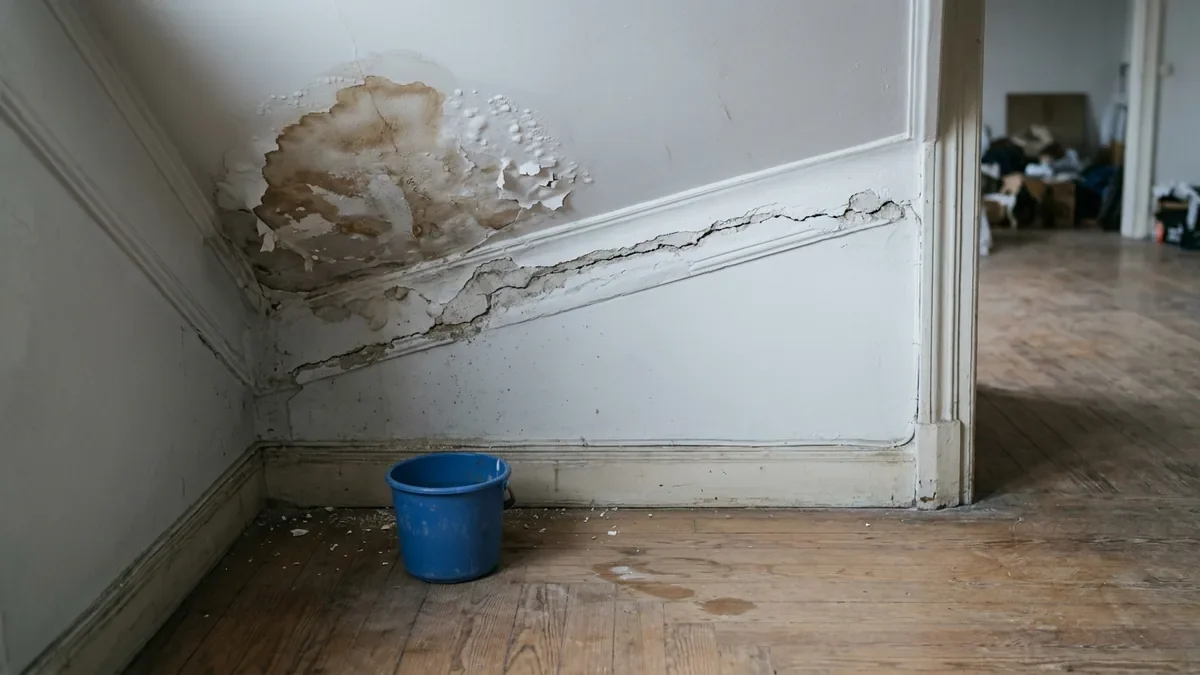
- The ceiling stain is misleading: water runs along the slab and appears far from the entry point.
- If the failure is localised, repair that point; if the deterioration is general, redo the waterproofing.
- At medium quality, waterproofing costs around 86 €/m² and redoing the whole roof around 166 €/m² (guide prices, VAT not included).
- Cleaning drains and checking joints once or twice a year prevents a good share of leaks.
Where the water really enters: the five weak points of the roof
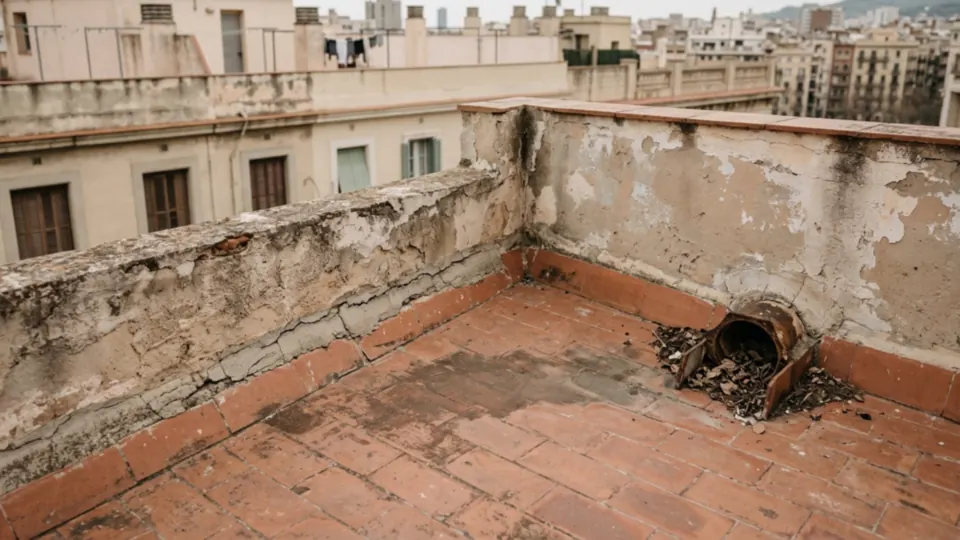
The roof has five weak points, and almost every leak comes from one of them. Ordered by how often they appear on site: the junction with the parapet or perimeter wall, drains and downpipes, joints and cracks in the surface, the points where chimneys, aerials or ducts pass through, and the puddles that form where the falls have been lost over time.
The junction with the parapet is the classic. There the membrane or finishing mortar cracks with expansion, and water gets in behind. Drains fail for another reason: leaves, soil and dirt block them, the water stands and ends up finding any gap.
In old buildings in the Eixample and Gràcia, when we are called out for a leak, the water almost always enters at a junction with the parapet or through a half-blocked drain, and not through the middle of the roof. Until we go up and look, the ceiling stain is misleading.
Broken tiles (rasillas) or tiles with an open joint also count, but they are less common than people think. If the flat above in the building was renovated years ago, also check what is left of the services that pass through the roof.
How to find the source before touching anything
You find it in three steps: look at the stain, go up to the roof with a mental map of what lies below, and test with water zone by zone. Skipping this order is the most expensive way to fix a leak.
First, look at the stain: its shape, whether there is mould or salts, whether it grows only after rain or also in dry weather. If it appears without rain, it may not be a leak and the source may be something else (for that, see damp treatment). Second, go up and walk the surface calmly: drains, junctions with the parapet, joints, cracks, anything that sticks out.
Third, the water test. The drain is plugged and a small area is flooded; if nothing happens within a few hours, you move to the next one. It is slow, but it identifies the point with a reliability that no hunch matches.
Why is the stain not right below the entry point? Because water travels between layers, moves along the slab and comes out wherever it finds a way: a crack, a change of level, a beam. It can appear several metres from the real failure.
Can you repair with the roof wet? To locate the leak, yes, and it is better. To repair, no: most sealants and membranes need a dry base, and sealing over damp only hides the problem for a few weeks.
Repairing one spot or redoing the waterproofing: the criterion
You repair when the problem is localised and the rest of the waterproofing is sound; you redo it when the deterioration is general. The practical test is simple: can you point with a finger to where it fails?
Repair is worth it if there is an open joint, a badly sealed drain, a cracked junction with the parapet or a small area of lifted tiles. These are jobs of a few hours or one or two days, with bricklaying help and sealing material.
Redoing is worth it if there are cracks across the whole surface, the membrane is crazed or has come away, several leaks appear in different places or the same area has already been repaired several times. Patching an exhausted roof means paying twice. Each patch adds a new weak point at its edge.
Watch out for an in-between case: the water enters through a common area and affects several flats. Then the problem is not one neighbour's but the owners' community's. The roof is usually a common element, although it is worth checking the statutes and the constitutive title, and the community itself decides how to deal with it, by the majority set by law and the statutes (Book Five of the Civil Code of Catalonia is the reference rule).
And if you decide to redo it, use the chance to think about what to do with the surface. If you are thinking of using the roof, that is a different job, with different regulations and a different budget.
What each option costs
Redoing the waterproofing costs 28 €/m² at functional quality, 86 €/m² at medium and 96 €/m² at high; redoing the whole roof rises to 97, 166 and 222 €/m² respectively. Guide prices · VAT not included. Not a binding offer: the fixed quote comes after the free technical visit.
| Item | Functional | Medium | High |
|---|---|---|---|
| Waterproofing (€/m²) | 28 € | 86 € | 96 € |
| Roof, refurbishment (€/m²) | 97 € | 166 € | 222 € |
| Bricklaying help (item) | 320 € | 399 € | 641 € |
| Rubble removal (€/m³) | 28 € | 41 € | 65 € |
The sum that matters is this: at medium quality, redoing the whole roof costs almost twice as much per square metre as waterproofing. If the base is sound, waterproofing is enough and is the logical choice. If the base is damaged, waterproofing on top is throwing money away.
A one-off repair involves bricklaying help, sealing and rubble removal, and is priced after seeing the entry point. It is a short job that is nothing like redoing the whole roof.
The paperwork is separate. If the work does not touch the structure or the façade, a prior works notification to the town hall is usually enough. The "Licences and technicians" item in our quotes ranges from 106 € to 2,450 €, depending on the procedure. If structural elements are involved, it is worth confirming with a technician. A fixed quote broken down by item lets you see how much is repair, how much is waterproofing and how much is paperwork.
Maintenance calendar for a Catalan-style flat roof
A well-maintained roof is checked twice a year: in autumn, when the leaves fall and before the heavy rains, and in spring, to see what winter has left. It is a half-hour check, not a building job.
At each visit, clean the drains and check that water runs off without standing. Look at the joints with the parapet and the tiles, remove vegetation taking root in cracks and look for puddles that take a long time to dry after rain.
After a heavy storm or any work that has passed through the roof, go up again. And avoid putting heavy items or new fixings on the roof without someone checking the waterproofing around them.
When a one-off repair no longer holds, the next step is to redo the roof. Better to decide calmly than with water already falling inside the home.
Frequently asked questions about roof terrace leaks
Why is my Catalan-style flat roof leaking if there is no visible damage?
Usually the water enters at a small point, such as a junction with the parapet, a blocked drain or an open joint, and travels between layers until it comes out far away. The ceiling stain rarely matches the entry point, which is why a water test is needed.
How often should a flat roof be checked?
Twice a year is a reasonable frequency: in autumn, before the rains, and in spring. It is also worth going up after a heavy storm or after any work that affects the roof. Cleaning the drains is what prevents the most leaks.
Who pays for roof repairs, the neighbour or the owners' community?
The roof is usually a common element and the community covers it, but it depends on the constitutive title and the statutes, for example if one flat has private use of it. It is worth checking them and consulting the administrator or a technician before ordering anything.
How much does it cost to waterproof a flat roof per m²?
As a guide and without VAT, 28 €/m² at functional quality, 86 €/m² at medium and 96 €/m² at high. Redoing the whole roof rises to 97, 166 and 222 €/m². The fixed quote is set after the technical visit.
Further reading
- Urgent repair of damp and leaks in a home - To know what to do in the first hours if water is already coming into the home.
- Damp treatment in Catalonia - To tell a leak apart from damp that has another source.
- What is a Catalan-style roof - If you want to review how the system is built before diagnosing its failures.
- Roofs and roofing in Catalonia - When a one-off repair is not enough and the roof has to be redone.
- Rooftop renovations in Catalonia - If, while redoing it, you are thinking of using the roof terrace.
- Cracks in walls and ceilings: which ones matter and which don't (partition vs structure) - To interpret the cracks that appear in the ceiling under the leak.
- Radiators not heating evenly: bleeding and balancing step by step - If you need to check the heating after the roof work, here you will see how to read the symptoms and what you can do yourself.
Keep reading
Common defects in Eixample buildings (Cerdà): ITE, courtyards and façades
The most common structural defects in Barcelona's Eixample buildings in 2026. A guide to the ITE inspection, damp, downpipes and façade repairs.
Restoration and façadesFaçade rehabilitation in Barcelona: when it is required and costs
If your residential block is close to 45 years old, the ITE can require you to rehabilitate the façade. We explain when it is compulsory, what it costs per m² and which deductions can reduce the bill.
BathroomsHow a bathroom is renovated step by step: the order of the works
Protection, demolition, drains, electrics, waterproofing, tiling and fittings: the order of the trades and what is tested before anything is covered up.