

Radiators not heating evenly: bleeding and balancing step by step
Cold at the top is air, cold at the bottom is sludge, the furthest one needs balancing. Here is what you can fix yourself and when to call a heating engineer.
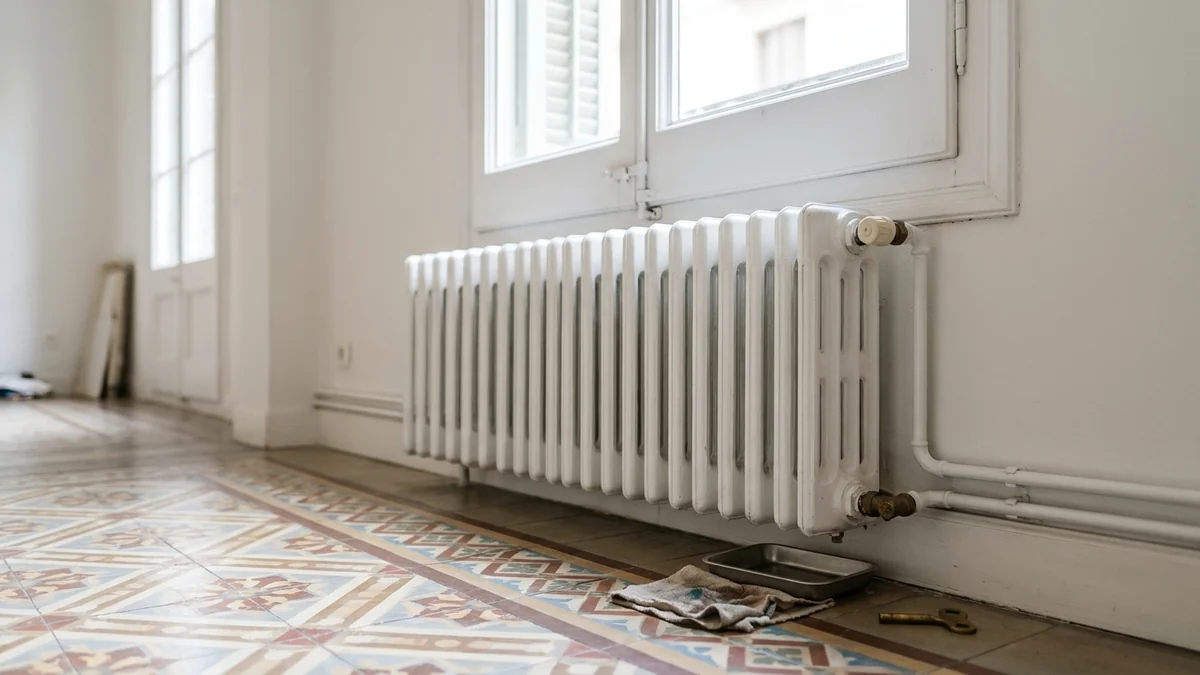
Why do some radiators heat and others do not, and is bleeding enough?
If some radiators heat and others do not, bleeding is not always enough: it depends on where the cold is. Cold at the top is usually air, cold at the bottom points to sludge, a cold radiator furthest away means the system is unbalanced, and if none heats up the fault is in the boiler or the pump.
Before touching anything, work out which symptom you have. A bleed key solves one of the four cases; the other three need something else.
Key points
- Radiator cold at the top and hot at the bottom: air in the circuit, fixed by bleeding.
- Radiator cold at the bottom and hot at the top: built-up sludge, the circuit needs cleaning.
- The radiator furthest from the boiler is cold: the circuit is unbalanced and is adjusted with the lockshield valves.
- If the boiler pressure drops after bleeding, top up the water with the filling loop to the pressure the manufacturer states.
- If no radiator heats up, bleeding is not the answer: check the boiler, the pump and the electrical supply.
Where the cold is tells you what is wrong: air, sludge, imbalance or boiler
The cold area of the radiator is the best diagnosis you have without tools. Put your hand on the top, the bottom and both corners once the heating has been on for a while.
| Symptom | Likely cause | Who fixes it |
|---|---|---|
| Cold at the top, hot at the bottom | Trapped air | You, with the bleed key |
| Cold at the bottom, hot at the top | Sludge at the bottom of the radiator | Fitter (sludge removal or chemical cleaning) |
| The one furthest from the boiler, cold or lukewarm | Unbalanced circuit | You, carefully, or the fitter |
| All cold | Boiler, pump, thermostat or lack of pressure | Fitter or technical service |
Sludge is rust and particles that settle at the bottom and block the flow of water. It is mainly caused by an old iron circuit with water that has never been treated, and limescale makes the problem worse.
In old Barcelona flats with long-standing cast-iron heating, the radiator furthest from the boiler is often found to have been cold for years, with the owner taking it as normal. Until the circuit is drained and you see what comes out, you cannot know how much sludge is inside.
How to bleed a radiator step by step and how often
Bleeding is the only thing you can do without risk if the radiator is cold at the top, and it takes a couple of minutes per radiator. You need the bleed key (or a flat screwdriver, depending on the model), a cloth and a small container.
- Do it with the heating off and the radiators cold, so the water does not burn you.
- Start with the radiator closest to the boiler and move up a floor if your home has several.
- Put the container under the bleed valve, at the top of one side, and turn the key half a turn or less.
- You will hear air escape with a hiss. Close it when water starts to come out, without forcing it.
- Repeat on all the radiators and then check the boiler pressure gauge.
It is normal for the pressure to drop when bleeding. If it falls below what your boiler's manufacturer states, top up the water with the filling loop, slowly and watching the gauge. If it drops again within a few days, there is a leak somewhere in the circuit and bleeding is no longer the answer.
With a healthy system, bleeding once a year is enough, at the start of the heating season. If you have to do it every few weeks, something is letting air into the circuit.
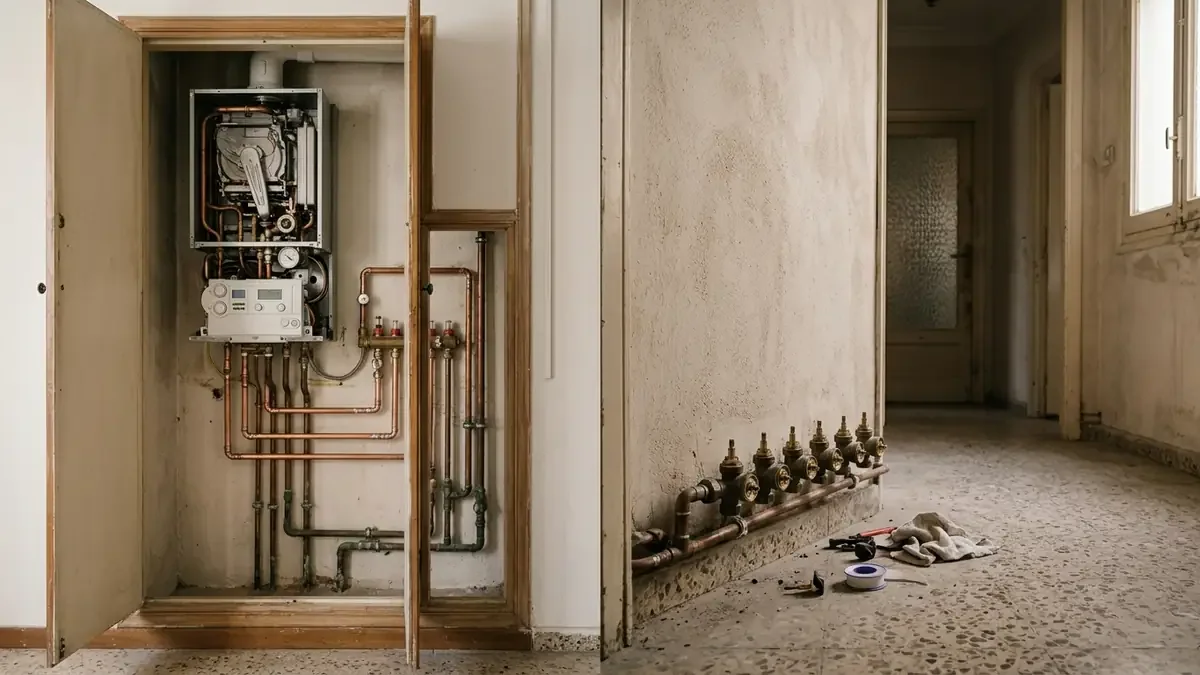
Balancing radiators with the lockshield valves: what you can do and what you cannot
Balancing means distributing the flow so the water does not all stay in the radiators close to the boiler. The adjustment is made with the lockshield valve, the small valve on the return side, normally covered by a cap.
The logic is simple: you close the lockshield valves of the nearest radiators a little and leave the furthest ones wide open. That way the water reaches all of them. Adjust gradually, a quarter turn at a time, and wait a few hours to see the effect.
However, if you do not know how far each one was open before, it is easy to leave the home worse off. Note the starting position of each valve before moving it. And if the circuit spans several floors or has years of sludge, balancing without cleaning first is of little use: the fitter does it with measurements, not by eye.
When to call the fitter and when the heating no longer deserves more patches
Call the fitter if the cold is at the bottom, if the imbalance persists after adjusting the lockshield valves or if the pressure drops on its own. And do not hesitate if no radiator heats up with the boiler on: it may be the pump, the thermostat or a power cut, as when a tripping RCD leaves the boiler without supply.
Sludge removal or a chemical clean of the circuit can restore service to a system that is still sound. But if there are repeated leaks, pitted pipes, radiators dripping at the joints or damp stains next to the pipes, you are paying for patches on something that has reached the end of its life.
My rule is this: for a single isolated repair, go ahead. From the second or third breakdown in a few seasons, that money is better spent on renewing the system.
What to do with old heating if you are renovating the flat
If you are already going to lift floors and open walls, it is the moment to decide what to do with the heating, because it costs more later. Replacing pipes with the floor up is a small item compared with opening it again.
With a full home renovation, the usual approach is to renew the whole circuit, replace radiators and leave the lockshield valves accessible and the system balanced from the start. With a partial renovation that does not touch the floors, you can limit the work to sludge removal, replacing the worst radiators and checking valves.
If instead of repairing it you prefer to change system, that is a different decision with its own analysis. And a fixed quote broken down by item tells you how much the heating takes within the works, so you can decide with data and not halfway through the renovation.
Frequently asked questions about radiators not heating evenly
Why is my radiator cold at the top and hot at the bottom?
Most likely there is air trapped at the top, which stops the hot water from filling it. It is fixed by bleeding the radiator with the heating off and cold. If the air returns within a few days, there may be an air leak into the circuit that should be checked.
What does it mean when a radiator is cold at the bottom?
It usually indicates sludge built up at the bottom, blocking the flow of water. Bleeding does not fix it. You need sludge removal or a chemical clean of the circuit by a fitter, and an assessment of the pipes if the system is old.
Why does the radiator furthest from the boiler not heat up?
Because the water stays in the nearby radiators and barely reaches the end of the circuit. It is a balancing problem, corrected by closing the lockshield valves of the nearby radiators a little and opening the distant ones. If there is sludge, it must be cleaned first.
Is it normal for boiler pressure to drop after bleeding?
Yes, as air and some water escape, the pressure drops. It must be restored with the filling loop to the value your boiler's manufacturer states. If it drops again within a few days without bleeding, there is a leak and a fitter should look at it.
Further reading
- Heating in Barcelona and Catalonia - See how a complete heating installation is planned when bleeding is no longer enough.
- Cracks in walls and ceilings: which ones matter and which do not (partition vs structure) - Useful if damp, stains or cracks appear next to the pipes when checking the radiators.
- Climate control and aerothermal heating in Catalonia - The next step if you decide to replace the heating with another system during a renovation.
Keep reading
Communal central heating and your renovation: what you can change in your flat
Which part of central heating is yours and which belongs to the owners' community, so you can renovate without breaking the circuit or falling out with neighbours.
InstallationsWhat is underfloor heating?
What underfloor heating is, how it works, water versus electric systems, the cost per m², the trade-offs and how to fit it in a renovation.
InstallationsHome automation in a renovation: KNX, Zigbee and smart home
Plan home automation into your full renovation. We compare KNX reliability, Zigbee flexibility and what Matter brings. An expert guide for 2026.