

Communal central heating and your renovation: what you can change in your flat
Which part of central heating is yours and which belongs to the owners' community, so you can renovate without breaking the circuit or falling out with neighbours.
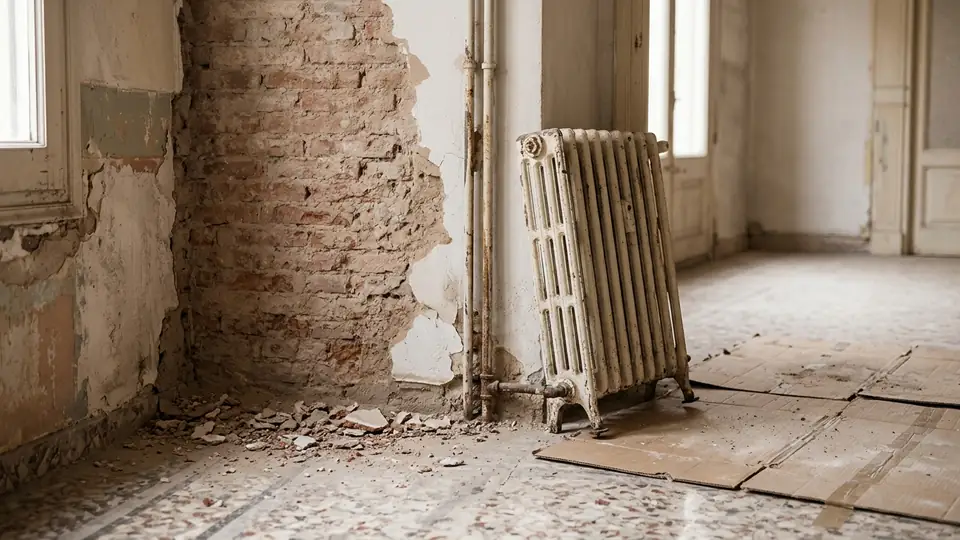
What can you change in your flat if the heating is central and communal?
With communal central heating, inside your flat you can change the radiator model, its position and the finishes around it, as long as you respect the communal circuit. Anything that affects the boiler, the risers or the distribution system depends on the statutes and the owners' community, not only on your renovation.
The key is knowing where what is yours ends and what belongs to everyone begins. You find that out before you break into walls, not after.
Key points
- Changing the radiator model and the finishes around it is usually your decision, if you do not alter the circuit.
- Vertical risers and the boiler room are common elements: do not touch them without consulting the community.
- Moving a radiator depends on the real pipe route, which you only see once the wall is opened.
- Opting out of central heating depends on the statutes and on the community's agreement.
- Ask the administrator in writing for the statutes and the installation plans before finalising the project.
What is yours and what belongs to the community in central heating
In general, the boiler, the plant room and the risers that run up the building are common, and the section that enters your home to feed your radiators is treated as internal installation. But "in general" is not an answer for a building site: the exact split is set by the statutes or the constitutive deed (título constitutivo).
So the first step is to read them. In Catalonia, horizontal property is governed by Book Five of the Civil Code of Catalonia (Llei 5/2006), which covers the regime of common and private elements. How large a majority each decision needs is explained in our article on renovations in owners' communities; we will not give figures here that are not ours to give.
In flats of the 60s and 70s with central heating, we almost always find, once the wall is open, that the radiator hangs from a riser that also serves the neighbour above and the one below. Until that route is visible, you cannot know how much room there really is to move it.
How do you know whether your flat has central heating? If there is no boiler or heating water heater in your home and the radiators are connected to vertical pipes, almost certainly yes. It is common in buildings from the post-war building boom (desarrollismo), and the housing types by neighbourhood guide helps you place yours. The property administrator can confirm it in five minutes.
Moving or changing radiators without breaking the circuit
Replacing an old cast-iron radiator with a panel or aluminium one, in the same place, is the simplest job and the one that causes the fewest conflicts. It is removed, replaced and reconnected to the same connections.
Moving it is another matter. If you shift it along the same wall, it is sometimes enough to extend a few lengths of pipe from the existing connections. If you move it to another wall or room, you need to see where the water comes from and where it returns, and in a shared circuit that conditions everything.
One thing to watch: while the works leave the radiator disconnected, the circuit must keep working for the other neighbours. That means shutting off, draining and refilling in a coordinated way, and warning the administrator in good time. Bleeding or draining without notice is the fastest way to earn a complaint at the residents' meeting.
And if you plan to cover or polish the floor, check where the pipes run: in many older flats they rise from the slab at the foot of the radiator. We cover this in the article on terrazzo floors.
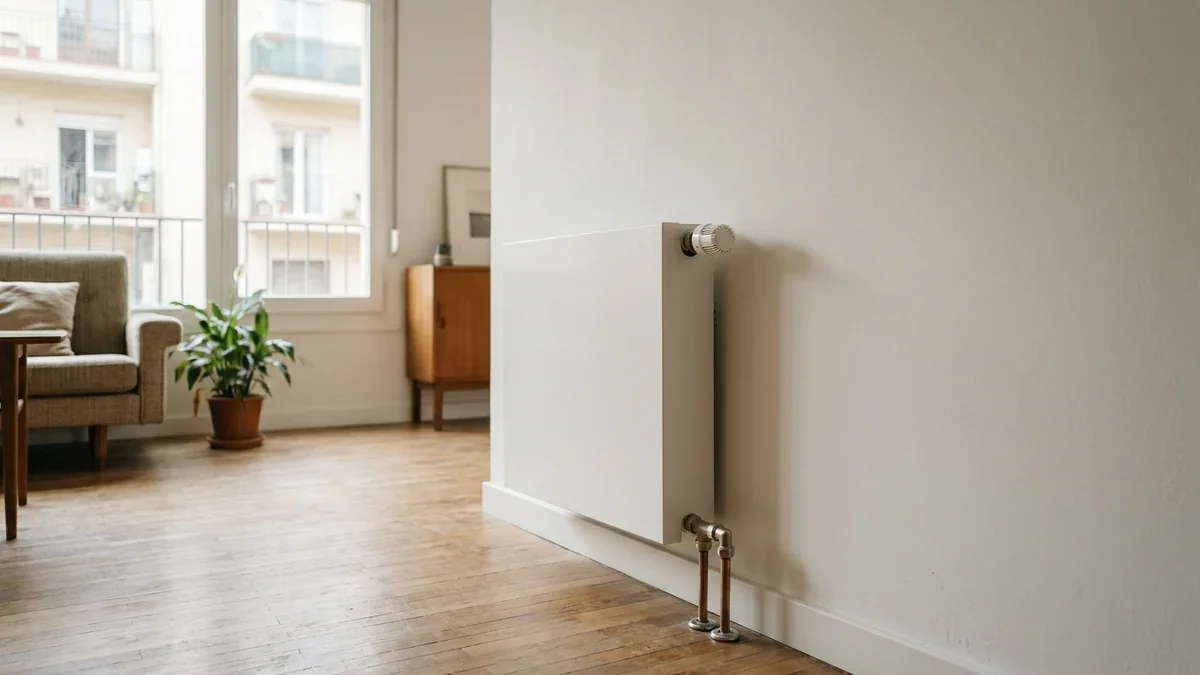
Valves and heat cost allocators: what you can touch and what you cannot
A thermostatic valve on a radiator is usually an internal improvement that does not alter the circuit, but you should confirm it with the community's technician or the building's installer. Depending on how the installation was done, changing one valve can affect the balance of the rest.
Heat cost allocators measure each home's consumption in order to share the heating cost. If your building has them or is going to have them, the system belongs to the community, not to you: do not remove or move them during the works. We do not state here what specific obligations apply to them without an official source; check with the administrator or a technician.
What we can tell you from the building site: protect the valves and meters during the works and keep access clear. A kitchen unit or a plasterboard casing that covers a shut-off valve is a future problem for you and for your neighbour.
Opting out of central heating: what the statutes say
Opting out of central heating is not a decision you take alone during your renovation. It depends on the statutes, on the community's agreement and on how it affects the common installation, and you should consult a technician and a lawyer or administrator before raising it.
There are reasons it is delicate. Disconnecting your home can upset the balance of the circuit and the sharing of the community's fixed costs. Some communities allow it with conditions, others do not. If you cannot find the answer in the statutes, ask for it to be discussed at a meeting.
What about underfloor heating? With communal central heating it is not an installation you can simply decide on: it needs a different flow temperature from radiators, and it depends on how the building's system is designed. Consult the technician first; do not improvise.
How to approach it before the works start
Before opening anything, ask the property administrator for three things: the statutes, the heating installation plans if they exist and the name of whoever maintains it. With that you know what is common and who to notify.
Then, at the technical visit, show the technician where the connections are and what you want to change. In a full home renovation, if pipes have to be touched, inspection openings are made before the fixed quote is closed, so the heating item is not an unknown halfway through the works. At Tu Nuevo Piso we do that technical visit at no cost.
And notify the community of the works in writing. If something that is common turns up when you open up, who pays for the repair is decided with the statutes in front of you, not in the corridor.
Frequently asked questions about central heating and renovation
Can I move a radiator if I have central heating?
You can move it if you do not alter the common circuit. Relocating it within your home depends on the real route of the pipes, which can usually be seen when the wall is opened. A technician should assess it, and you should warn the administrator before the water is cut off.
Can I fit thermostatic valves on a central heating radiator?
Normally yes, because it is work inside your home, but it can affect the balance of the circuit. Confirm it with the technician or the building's installer before fitting them, and check whether the statutes or the community say anything.
Can I opt out of my community's central heating?
It depends on the statutes and on the community's agreement. It is not something you decide alone in your renovation. Check the statutes, ask the administrator and have a technician assess how it would affect the common installation.
Do I need the community's permission to renovate the heating in my flat?
To change radiators inside your home without touching the circuit, notifying is normally enough. If you affect risers, the boiler room or other common elements, you need to consult the community in line with the statutes and the law.
Further reading
- What type of flat you have, by Barcelona neighbourhood: building types and what a renovation finds - It helps you place your flat by neighbourhood and building type, which is usually what tells you whether there is central heating.
- Renovations in owners' communities: majorities, quorums and costs - The detail of how the community decides when what you want to touch is common.
- Heating in Barcelona and Catalonia - How we approach heating installations in a renovation, for when you already know which part is yours.
- Full home renovations in Barcelona for old flats, houses and commercial premises - If heating is part of a larger renovation, see how the complete project is organised with a free technical visit.
Sources
Keep reading
Radiators not heating evenly: bleeding and balancing step by step
Cold at the top is air, cold at the bottom is sludge, the furthest one needs balancing. Here is what you can fix yourself and when to call a heating engineer.
InstallationsReplacing pipes in a flat: when it is needed, materials and cost
Is it time to replace the pipes in your flat? Learn when a plumbing renewal is essential, which materials to use (multilayer, PEX) and what it costs in 2026.
InstallationsAerothermal and climate control in a full renovation: 2026 guide
A full renovation is the best moment to switch to aerothermal heating and sort out year-round climate control. Here is how it works, what it costs and which grants you can use in 2026.