

Large-format tile or metro tile: joints, rectified edges and which to choose
Rectified large-format tile gives thin joints and needs a flat wall; metro tile forgives uneven walls but has more grout to clean.
Indicative prices · VAT not included. Not a binding offer.
Large-format tile or metro tile?
Rectified large-format tile leaves very thin joints and needs a very flat wall or floor. Metro tile, with its small size and bevel, hides irregularities in the surface better, but has many more joints to clean. There is no overall winner: it depends on the state of the wall, the room and how much grout you can live with seeing.
Here is the comparison based on what really changes on site: rectification, the joint, the surface and cleaning. And the little that can be said about prices without inventing anything.
Key points
- Rectification is a final cut of the tile that allows joints of 1-2 mm, compared with 3 mm or more for an unrectified tile.
- One square metre of metro tile has about 20 linear metres of joint; with 60×120 cm large format, about 2.5 m.
- Large format does not forgive a wavy wall: the surface must be made flat before laying, and that is base work and cost.
- Laying wall tiling runs at 23-58 €/m² and laying ceramic flooring at 27-73 €/m² (guide figures, VAT not included); the tile itself is priced separately.
- In an old flat the wall decides: choose the format after seeing the state of the surface, not before.
What rectification is and why it changes the joint
A rectified tile is one that, after firing, is cut on all four edges so that every tile measures exactly the same. Firing leaves small differences in size, and rectification removes them.
What does this mean in practice? The tiles fit almost edge to edge. With rectified tiles the usual joints are 1-2 mm. An unrectified tile, with its natural edge, needs a wider joint, 3 mm or more, to absorb those differences without the lines going crooked.
It helps not to mix up the concepts. Rectified is not the same as large format, although almost all large-format porcelain is rectified. And metro tile, the classic bevelled rectangle, is usually a small tile (7.5×15 cm or 10×20 cm are common sizes) and may or may not be sold rectified. What you see in an old-building bathroom, with that shine and that marked joint, is usually unrectified.
| Feature | Rectified large format | Metro tile |
|---|---|---|
| Usual sizes | 60×60, 60×120, 120×120 cm | 7.5×15 or 10×20 cm |
| Usual joint | 1-2 mm if rectified | 2-3 mm or more, depending on the edge |
| Edge | Straight, cut square | Bevelled, slightly domed |
| Visual effect | Almost continuous surface | Marked pattern, classic look |
| Surface tolerance | Very low | Wider |
These are the usual market sizes, not a standard. Each range has its own, so check them on the tile data sheet.
How much joint you see and how much each format gets dirty
With metro tile you see and clean much more grout than with large format, and that can be counted. In one square metre of 7.5×15 cm tile there are about 20 linear metres of joint; with 10×20 cm tiles, about 15 m; with 60×120 cm large format, around 2.5 m.
This is an approximate count that does not include the perimeter joints, but the proportion is what matters. There is about eight times more joint with small metro tile than with large format.
Cement grout is porous. It holds grease in the kitchen, limescale at the tap and damp in the shower, and it is where mould and darkening show up first. That is why metro tile needs more upkeep in splash zones. Epoxy grout exists, which cleans better and resists stains more, but it changes how it is worked, and you should confirm with the installer whether it pays off in your case.
And now the part almost nobody mentions about large format: less joint is not zero upkeep. The porcelain tile itself cleans with a cloth, but the remaining joint stands out more, because it contrasts with a smooth, continuous surface. If it gets dirty or fades, it shows.
There is an aesthetic reason why metro tile is still so popular. The grid of joints is part of the design. Anyone who wants a bathroom with character, with an old-building feel, usually wants exactly that to show.
What each format demands of the wall and floor
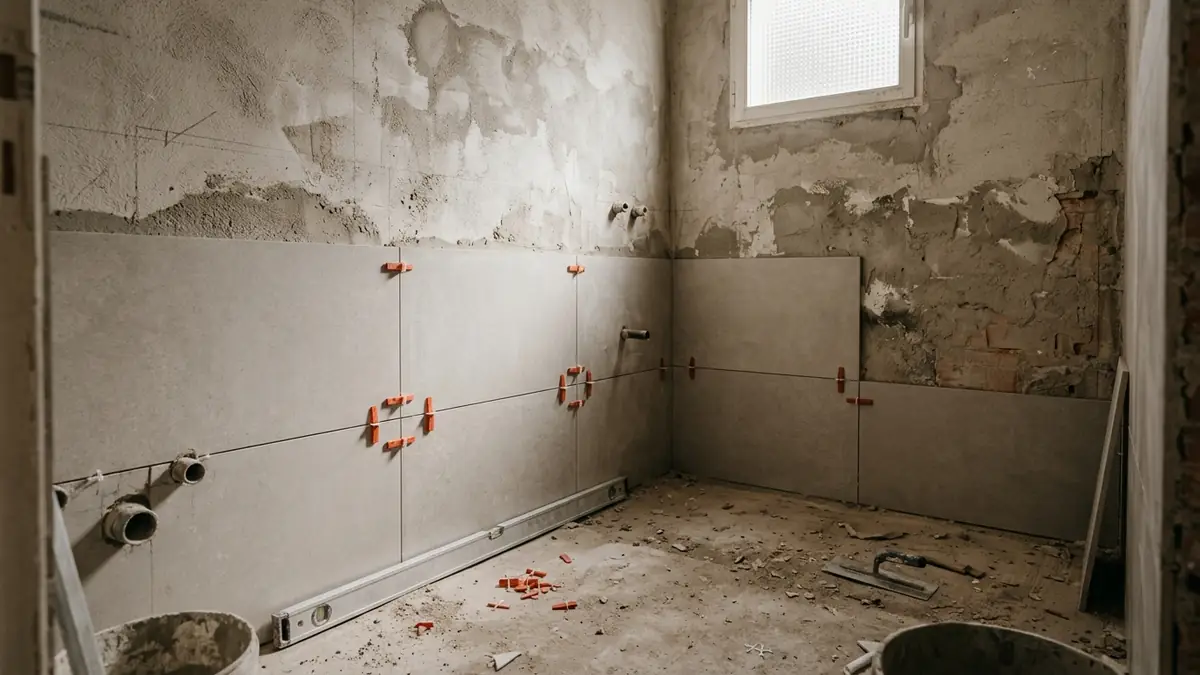
Large format demands a genuinely flat surface, and metro tile forgives quite a lot more. A big tile does not follow the waves in a wall: it rests on the high points and leaves gaps at the low ones, and the result is lips between neighbouring tiles, cracks or tiles that sound hollow.
In old flats in Gràcia and the Eixample we almost always find walls that, with the straightedge on, have waves of several millimetres; until the old tiling is stripped you do not know how much base work a large format needs. Some walls are ready after a good render coat. Others need whole sections redone.
With small tiles the opposite happens. Each tile follows the wall a little, and the joint and the bonding mortar spread out the uneven areas. It is not that you can lay on anything, but the tolerance is clearly greater.
Can you put large tile over old tile? It is possible if the existing tiling is well bonded and flat, but in an old flat we almost never recommend it. It adds thickness, hides the problem instead of solving it and forces you to rethink frames, sockets and finishes. Stripping it and leaving a new base works out better.
On the floor the logic is the same, with an extra. A large-format floor shows even more, because a wave in the floor is visible in raking light and felt underfoot. Before deciding the format, the floor needs a screed or levelling, and that item must appear in the quote, not turn up afterwards.
And the laying itself is different. A 120 cm tile is heavy, breaks if handled badly and usually calls for double-buttering and two people. It is skilled work, and you should know from the start who will do it.
Bathroom, kitchen and shower: where each wins
On a bathroom wall in good condition, large format wins; on a kitchen splash zone and on a doubtful wall, metro tile usually wins. But it depends on the area, and they are not all the same.
Shower wall. This is where large format is best justified. Fewer joints means less mould, and a porcelain tile of 60×120 cm or more covers the shower height with few cuts. That said, the waterproof base must be done properly before anything is stuck on; bathroom waterproofing matters more than the format.
Shower floor. Here large format gets complicated. A floor sloping to the drain calls for small tiles or very carefully measured cuts, and the tile must also be slip-resistant. If the bathroom has a shower tray, the problem disappears. With a built-in walk-in shower, metro tile or mosaic adapt better to the slope.
Rest of the bathroom. A small bathroom with large format gains a sense of space, because the eye runs on without breaks. With metro tile, the bathroom looks warmer and more crafted. It is a matter of taste, but also of how much you are willing to clean.
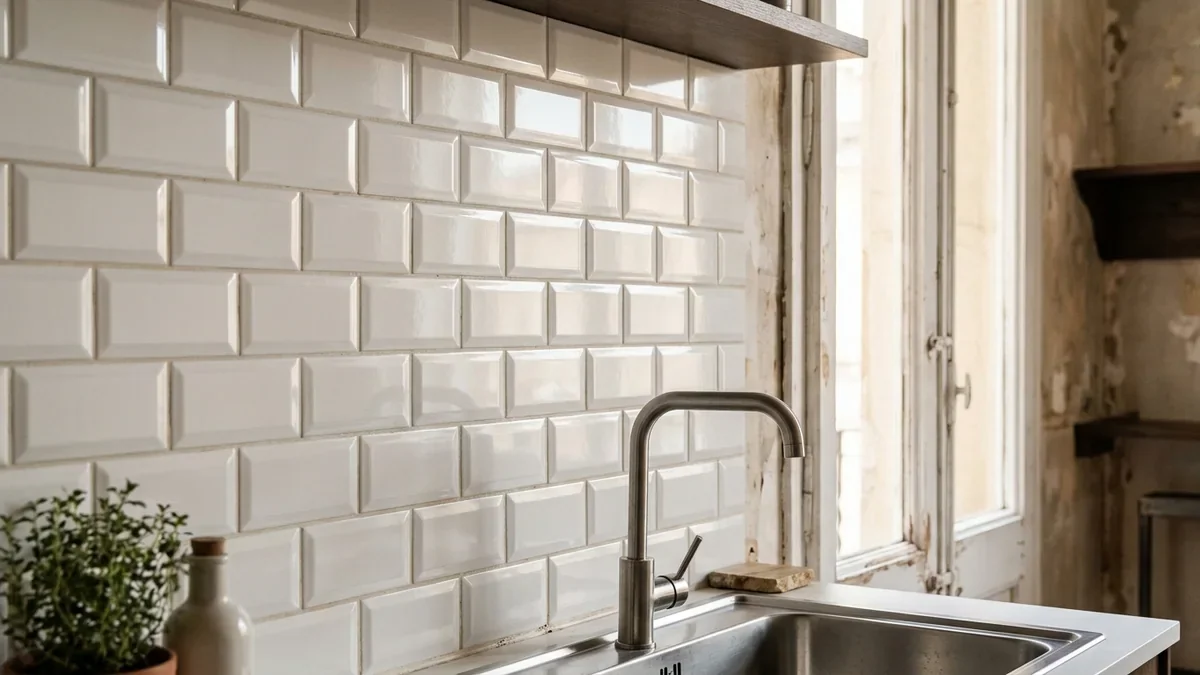
Kitchen splashback. Metro tile works very well behind the worktop: the small tile is easy to cut around sockets, hood and outlets, and if one tile breaks, it can be replaced. Large format also works, with few joints and easy cleaning, but it forces you to measure socket openings precisely. If you are deciding a full kitchen renovation, the format of the splashback is settled together with units and worktop.
Floor and wall at once, with the same tile? You can, and it looks continuous, especially in small bathrooms. But the floor tile must be slip-resistant, and that version rarely has the same finish as the wall one. Almost always you have to choose two finishes from the same range.
Large-format tiles on the floor also bring another decision: how the skirting board and the junction with the wall are resolved. Better to think about it from the start, with the format chosen.
What they cost to lay: what can be said
The only firm figure we can give is the generic laying cost, not the cost of the tile or a comparison between formats. In our price table, wall tiling (laying) runs from 23 to 58 €/m² depending on quality, and ceramic or porcelain flooring (laying) from 27 to 73 €/m². These are guide prices, VAT not included, and not a binding offer: the fixed quote comes after the free technical visit.
| Item (guide, VAT not included) | Functional | Mid-range | High |
|---|---|---|---|
| Wall tiling (laying), €/m² | 23 € | 30 € | 58 € |
| Ceramic / porcelain flooring (laying), €/m² | 27 € | 40 € | 73 € |
| Smoothing / plastering of walls and ceilings, €/m² | 15 € | 24 € | 25 € |
| Masonry: render coats and bases, €/m² | 36 € | 36 € | 38 € |
Guide prices · VAT not included. This is not a binding offer: the fixed quote comes after the free technical visit.
Look at what the table does not say. It does not say that large format costs more or less than metro tile, because these figures are for generic laying and do not distinguish by tile size. And it does not include the price of the tile, which depends on the range, the thickness and the finish, and which we are not going to invent here.
What you can do is look at the base items. The last two rows are the ones that really change when the wall is in bad shape: if you have to render and smooth first, that cost appears whatever the format, but with large format it is hard to avoid.
So when you compare two tiling quotes, ask what they include for surface preparation and what tile format they assume. A fixed quote in writing, broken down by items, saves you discovering halfway through the job that levelling was not counted.
How to decide at a visit: the wall rules
The decision is made with the straightedge in hand, not from the catalogue. When we visit an old flat, the first thing we look at is not which tile you like, but the state of the wall, and the real range of options comes from that.
If the surface is good or can be made flat with reasonable work, rectified large format is a solid option, especially in the shower and in small bathrooms. If there are many waves, old damp or sections that would be expensive to redo, metro tile is the honest way out. It is not meant to deny you a nice finish: a badly bedded large format shows every day, and fixing it means lifting it.
One question that helps to decide: how much joint can you stand to see and clean? If any line bothers you, go for large format and accept the preparation. If you like the pattern and do not mind running a brush over it now and then, metro tile gives a friendlier, less demanding finish.
Some quick criteria we use:
- Measure the flatness of the wall with a long straightedge before choosing a tile.
- Decide which areas get large format and which metro tile; you do not need just one throughout the bathroom.
- Ask for the surface preparation item to be listed separately in the quote.
- Confirm that the floor tile is slip-resistant in wet areas.
- Ask who lays the large format and with what bonding system.
If you are unsure between porcelain and other floor materials, that is another comparison that deserves its own analysis. Here we have talked only about the format of the ceramic tile and what it asks of the surface.
Frequently asked questions about large-format tile and metro tile
What does it mean for a tile to be rectified?
After firing, it is cut on all four edges so that all the tiles measure exactly the same. That allows them to be laid with very thin joints, usually 1-2 mm, compared with 3 mm or more for an unrectified tile. Almost all large-format porcelain is rectified.
Which tile gets dirty less, large format or metro?
The large one, because it has much less joint, and the joint is what holds grease, limescale and mould. In one square metre there are about 20 linear metres of joint with small metro tile and about 2.5 m with 60×120 cm large format. The tile itself is just as easy to clean.
Does the wall need to be flat to lay large-format tile?
Yes, it is what it demands most. A large tile does not follow the waves: it rests on the high points and leaves gaps at the low ones. In old flats you usually need to render or smooth first. That preparation should appear as its own item in the quote.
Can you lay large tile over old tile?
It is possible if the existing tiling is well bonded and flat, but in an old flat we almost never recommend it. It adds thickness, hides the problem and complicates the finishes. Stripping it and preparing a new base usually gives a longer-lasting result.
How much does wall tiling cost per square metre to lay?
In our price table, laying wall tiling runs from 23 to 58 €/m² depending on quality, and laying ceramic flooring from 27 to 73 €/m². These are guide figures, VAT not included, without the tile or the surface preparation. The fixed quote comes after the technical visit.
Further reading
- Bathroom renovations in Barcelona - See how a complete bathroom is planned, where the tile format is decided together with the other items.
- Kitchen renovations in Barcelona - If the covering is for the kitchen splashback, here you see how it fits with units and worktop.
- Waterproofing in a bathroom renovation: materials, regulations and common mistakes - Before laying any tile in a wet area, the waterproof base decides whether it lasts.
- Floors and flooring in Catalonia - For ceramic floor tiles and laying options in Catalonia.
- Which floor to choose: porcelain, parquet, microcement or vinyl - If you are unsure between porcelain and other floors, this comparison gives you the full picture.
Keep reading
Which floor to choose: porcelain, parquet, microcement and vinyl compared
A practical comparison of floors for 2026 renovations: porcelain stoneware, parquet, microcement and SPC vinyl, with costs, pros, cons and installation.
Materials and finishesTypes of paint for your home: emulsion, enamel, mineral and stucco
A 2026 guide to paint for the home. We compare emulsion, enamel, mineral paint and stucco: the differences, best uses and coverage per litre.
Materials and finishesWhat is microcement and where is it used?
What microcement is, its pros and cons, where to use it (floors, bathrooms, kitchens) and why it has become a go-to finish for 2026.