

Annual maintenance plan for an owners' community: a month-by-month calendar
What to check in the building and in which month: roof and downpipes in autumn, façade and flat roof in good weather, and how to record it all for the ITE.
What does an owners' community have to check, and in which month?
An owners' community should spread its checks by season: roof, downpipes and courtyards before the autumn rains, façade, flat roof and balconies in good weather, and shared installations in winter. This is a calendar of good trade practice, not a list of legal obligations.
Whatever has a fixed date by regulation (lift, fire protection, gas, legionella) is set by your maintenance company, and it is not something to improvise.
Key points
- Preventive maintenance is good trade practice: it organises checks by season and stops a small fault from ending up as an emergency job.
- September and October are the months for the roof, drains, downpipes and courtyards, before the first heavy rains.
- Façade, flat roof and balconies are checked in good weather, from March to August, when it is safe to work at height.
- Lift, fire protection, gas and legionella have set intervals under sector regulations: confirm them with your maintenance company.
- Every check recorded in the Building Book is useful paperwork when the ITE comes round.
What a preventive maintenance plan includes and what is not an obligation
A preventive plan is a calendar of visual checks and small interventions that the community decides to carry out so the building does not deteriorate. Most of it has no interval set by regulation. What does have one is concentrated in a few regulated installations.
It helps to separate three things. First, regulated checks, which have their interval set by sector regulations and are carried out by an authorised company. Second, routine trade maintenance, which is what this article describes: look, clean, record. And third, emergency works, which is what appears when the second was not done.
The difference between prevention and emergency shows in the invoice and in the mood of the owners' meeting. Cleaning a drain is a morning's work. Redoing a false ceiling and the waterproofing beneath it because water had been getting in for months is a different conversation, with a special levy included.
Who decides and commissions the work? The owners' meeting, normally through the administrator or the president, and always according to what the law and the community's statutes set. In Catalonia the reference is Book Five of the Civil Code of Catalonia (Codi civil de Catalunya). If the calendar is approved once a year, together with the budget, nobody has to improvise in the middle of a storm.
One warning: this calendar is a guide. Each building has its own roof, courtyard and installations, and a technician who has visited it will adjust dates and frequencies better than any general list.
September and October: roof, downpipes and courtyards before the rains
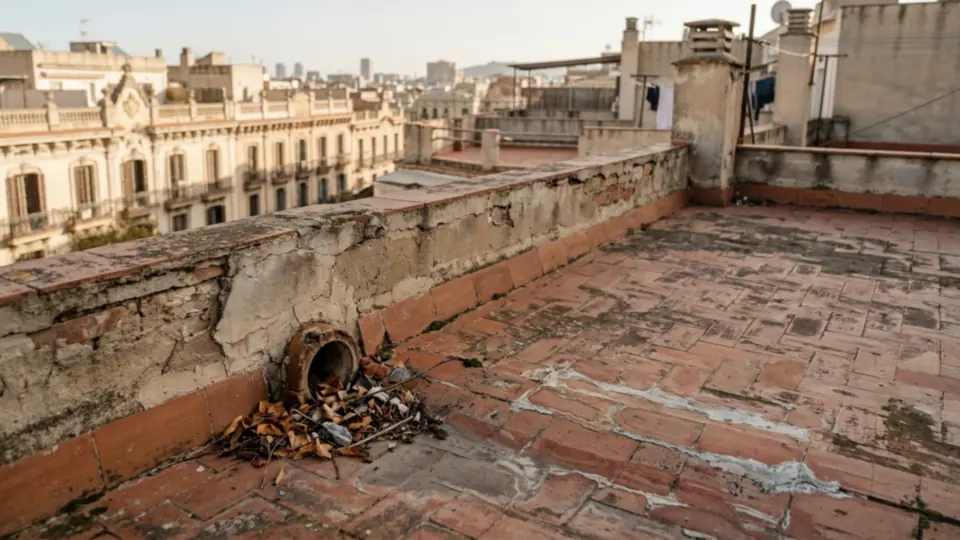
September is the month to look at everything that carries water: roof, flat roof, drains, downpipes and courtyards, before the first heavy autumn storm arrives.
In the old buildings of the Eixample and Gràcia we almost always arrive after that first storm: a blocked downpipe or a roof drain full of leaves that nobody had looked at for months. Until the false ceiling of the top floor is opened, the real extent of the damp cannot be seen.
This is what is usually checked in this period, as trade practice:
- Flat roof drains and outlets: clear leaves, soil and debris, and check that the water runs towards them and does not pool.
- Waterproofing: look for cracks, blisters, lifted areas and the joints with the parapet or any protruding elements.
- Downpipes: look at connections, joints and damp stains on the visible sections, and call a technician if there are smells or unusual water noises.
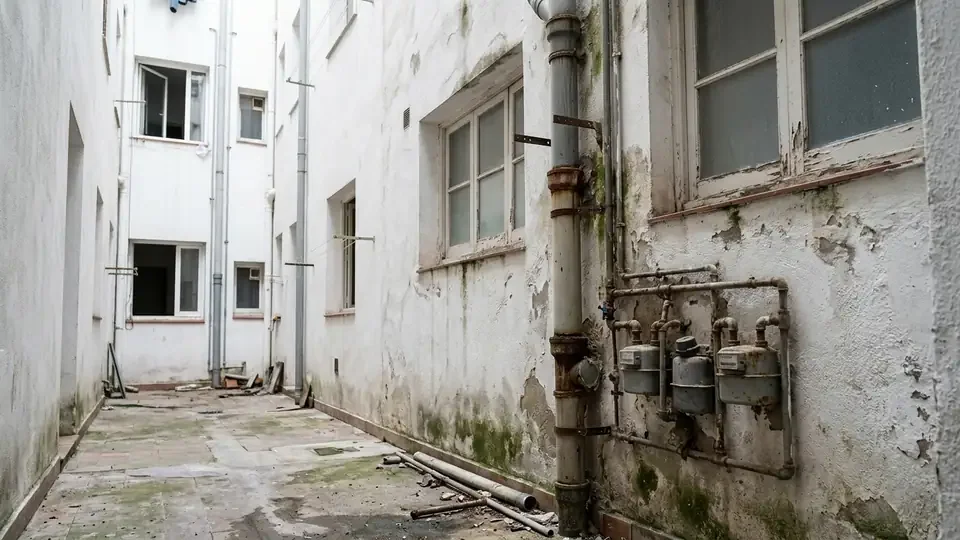
- Interior courtyards and light wells: remove rubble and objects, check the drain at the bottom and the ventilation outlet.
- Gutters and edges of a pitched roof, if there is one: moved tiles, broken pieces, joints with chimneys.
Note that almost all of it is cleaning and looking. No scaffolding or project is needed. Someone has to go up and do it before the rains, not after. For work at height, a professional with the right safety equipment is better than a well-meaning neighbour.
If the flat roof is used for drying laundry or leisure, wear is greater and the check should be more frequent. If you are thinking of going further, turning it into a walkable roof terrace changes the permits and the structure, and that is no longer maintenance.
And in case you doubt it: the damp you see on a top-floor ceiling almost never starts where the stain appears. Water travels through the floor slab before showing. That is why looking only at the ceiling is not enough; you also have to look above.
November to February: shared installations, entrance hall and interior areas
Winter is the time to check what is under cover: entrance hall, staircase, meter room and the shared electrical panel. With bad weather outside, interior work is done without time pressure.
What usually goes into this block:
- Electrical panel and main protection box (CGP) in shared areas: visual inspection for overheating, smells, protections that trip frequently. Any work on the installation is done by an authorised installer under the REBT (low-voltage regulations).
- Lighting in the entrance hall, staircase and garage: burnt-out bulbs, emergency lights that do not come on, motion detectors that fail.
- Meter room and risers: tidiness, signage, no damp and no stored objects.
- Staircase and entrance hall: steps, railings, handrails, anti-slip strips, loose floors or lifted tiles.
- Entrance doors, letterboxes, intercom and locks.
One thing we firmly stand by: the check of the shared electrical panel should not be left until the trip switch goes. In many buildings with old installations, the shared areas are the part that has gone longest without being touched, precisely because nobody considers it theirs.
It is also a good moment to walk round the building with a technician and make a list of what can be seen: cracks in staircase walls, damp in the entrance hall, flaking on the ceiling of the top landing. That list, with a date and photos, is the basis of next year's calendar.
And the downpipes appear again. After a few months of rain, if a ground-floor neighbour notices damp or a bad smell in the courtyard, do not wait for spring: tell whoever handles maintenance.
March to August: façade, flat roof and balconies in good weather
Spring and summer are the season for the façade, balconies and work at height, because with mild temperatures and no rain the work is done better and with less risk.
| Element | What to look at | When it suits |
|---|---|---|
| Façade | Cracks, loose rendering, areas that sound hollow when tapped, loose elements | March to June |
| Balconies and cantilevers | Condition of the edge, the railing, rusting reinforcement, leaks from the floor | April to July |
| Flat roof | Second check after winter: waterproofing, joints, pooling | May to July |
| Shared joinery and windows | Sealants, catches, glass on staircases and in courtyards | Summer |
| Party walls and parapets | Stability, finishes, joints with the roof | In good weather |
The table is a trade guide, not a mandatory calendar. Each building needs its own order.
The façade is looked at first from the street, with binoculars if needed, and then from close up with access equipment if there are doubts. A piece of rendering or a balcony element coming away is a risk to anyone passing below, so as soon as something sounds hollow or looks loose, a technician is called and the area is cordoned off.
Balconies deserve separate attention. In old buildings, rust on the reinforcement pushes the concrete and splits it from inside: we see it as flaking with brown stains on the edge. When that appears, it is no longer cleaning: it has to be assessed and probably repaired.
And the flat roof, second round. After winter, the waterproofing has suffered expansion, rain and, sometimes, footsteps. Looking in May or June allows repairs in good time before the next autumn. Repairing is always cheaper than redoing, but we give no figures here because they depend on the building and the technical visit.
When one of these checks uncovers something bigger, such as a balcony with exposed reinforcement or a façade at risk of falling away, you have to move from maintenance to works, and that requires a project, a technician and the community's agreement.
Regulated checks: lift, fire protection, gas and legionella
Lift, fire protection, gas installations and legionella prevention are the checks with an interval set by sector regulations, and each is carried out by an authorised company.
We give no intervals here, because they depend on the type of installation and the regulations that apply in each case. The right approach is to ask your maintenance company to state in writing which checks apply to your building and how often, and to confirm it with them.
| Installation | Who checks it | Interval |
|---|---|---|
| Lift | Authorised lift maintenance company | According to regulations and contract: confirm with your maintenance company |
| Fire protection (extinguishers, BIE hose reels, detection) | Authorised maintenance company | According to regulations and your maintenance company: confirm it |
| Gas (shared installation) | Installer or distributor company | According to regulations and your maintenance company: confirm it |
| Legionella (if there are risk installations) | Specialist company | According to regulations and your maintenance company: confirm it |
Good practice is to put these dates in the same calendar as everything else. Not because we carry out these checks, but because the administrator can see at a glance what falls in each month and avoid oversights.
If the lift is the recurring source of breakdowns, the question may no longer be the check but whether it is worth renovating or replacing it, or considering another accessibility solution. That is another decision, with its own sums.
How to link the calendar to the ITE and the Building Book
Every check that is done and recorded is one less document to hunt for when the technical building inspection arrives. The ITE looks at the general condition of the property, and an orderly maintenance history helps the technician understand what has been seen and what has been repaired.
The Building Book is the natural place to keep that information: the date of each check, who did it, what was found and what was repaired. It does not need to be a complicated document; what matters is that it is complete and that someone takes charge of updating it.
A simple routine works well:
- When approving the annual budget, the owners' meeting also approves the calendar of checks.
- Each check produces a short report with date, photos and observations.
- Anything detected that needs repair is prioritised: urgent, short term, to monitor.
- Everything is kept in one folder, digital or paper, that travels with the administrator.
This does two useful things. It stops a crack that was already seen three years ago being discovered "again" and argued over as if it were new. And it means that, when a larger job is needed, the technician starts from data and not from zero.
For ITE deadlines and requirements, consult a technician or the information from the Generalitat de Catalunya. Here it is enough to fix the idea that orderly maintenance is the best preparation for it.
If you prefer someone to carry out and record this calendar, it can be organised through a maintenance contract, with a free prior technical visit and a fixed quote in writing, so that each item is clear before starting.
Frequently asked questions about annual maintenance in an owners' community
What checks does an owners' community have to carry out?
The regulated ones, such as lift, fire protection, gas or legionella, are set by sector regulations and carried out by an authorised company; confirm with your maintenance company which apply to your building. The rest, such as roof, downpipes or façade, are good trade practice that the owners' meeting decides to carry out.
When should the roof and downpipes be cleaned?
It is usually done in September or October, before the first heavy rains, with another look after winter if the building has leaves or trees nearby. If there is recurring damp or blockages, a technician should check the cause.
Who decides and commissions maintenance in an owners' community?
The decision belongs to the owners' meeting, and the commission is usually handled by the administrator or the president. The majorities and the sharing of costs depend on the law and on each community's statutes.
What is the difference between preventive maintenance and emergency works?
Preventive maintenance is planned and done before damage occurs: cleaning, checking, repairing small things. Emergency works come when the problem has already caused damp, falling material or breakdowns, and are usually more costly and more disruptive for neighbours.
How do you record maintenance in the Building Book?
With the date of each check, who carried it out, what was observed and what was repaired, together with photos or reports if there are any. A complex format is not needed: it is enough that it is orderly and updated every time something is done.
Further reading
- Building maintenance in Catalonia - If you prefer someone to carry out and record this calendar, here is how maintenance by contract is organised.
- Technical building inspection (ITE) in Catalonia - This is where the year's checks turn into the building's official inspection.
- What is the Building Book - Where the checks and repairs carried out by the community should be recorded.
- Renovations for owners' communities in Catalonia - When a check uncovers work that is no longer maintenance, this is the next step.
Sources
Keep reading
Activity licence or works licence for a commercial unit: which comes first and how they fit together
The works licence and the activity licence are not the same thing, and they cannot be applied for in any order. Here is how they fit together before you rent or renovate a unit.
Commercial and communitiesOwners' community and renovation works: rules you need to know
A 2026 guide to how a Spanish owners' community works, its role in renovations, the limits on your works and the votes and permits you need.
Commercial and communitiesCommercial renovation in Barcelona: restaurants, offices and shops
Renovating a commercial unit in Barcelona is a business project where the activity licence, timescales and compliance matter as much as the design. This guide explains how to approach restaurants, offices and retail.